
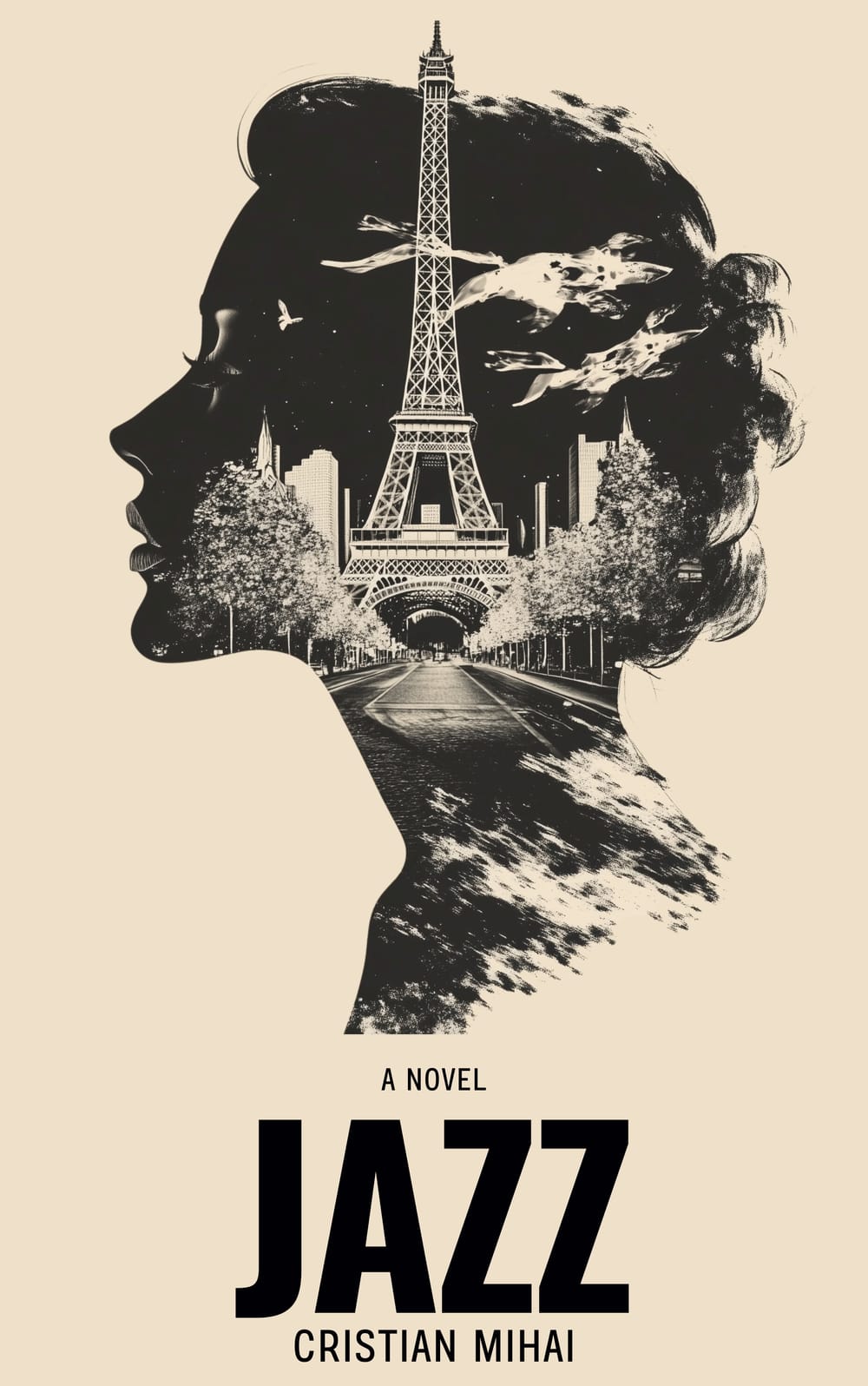
Jazz
A novel about a man who crosses an ocean to say three words to a woman who already knows them.
I have Stage IV Cancer. I may well only have 6 to 8 months to live. So I value time more than ever before. I only do what is important and worthy of my time.
Jazz was worth my time. — Bryan Edmondson
Jazz was hard for me to put down. I liked the ending and the relationship between the main character and his dream girl. I love how this book feels like it has it's own personality. – Saschia Johnson
Chris Sommers is twenty-three, broke, and blocked. A writer with nothing to say. A man with everything to want. When Amber disappears to Paris, he doesn't hesitate. Buys a one-way ticket to a city he's never seen, chasing a woman who never asked him to follow.
She isn't waiting for him.
She was never going to be waiting for him.
Some obsessions clarify. This one will cost him everything he thought he knew about love, about art, about himself.
Jazz is a novel about wanting what you cannot have. About the stories we tell ourselves to survive wanting. About the moment you finally reach the thing you've been reaching for and discover it was never really there.
The bartenders moved in formation, arms reaching for bottles, wrists turning at practiced angles. Taps hissed. Glass touched glass. The smell of spilled beer had soaked into the wood grain years ago and never left.
I took an empty stool, the seat worn to a shine that caught the low light.
The bartender wiped the same spot on the bar three times and tilted his head toward the back. He's with Oliver, he said. What are you having?
Same as my cousin.
He cracked open a Corona and the cap spun across the wood and dropped. The bottle cold against the glove leather. I drank and the lime burned bright at the back of my throat.
The double doors swung open.
Jay.
His tie hung loose. His shirt clung damp at the collar. He'd rolled his sleeves to the elbow and the bruises there had yellowed at the edges, a week old, maybe more. His beard had grown past the point of intention. He looked like he'd slept in a car.
We clasped hands. His grip tightened around my fingers and held.
He dropped onto the stool beside me and his eyes went to my hands.
What's with the gloves? You think you're royalty now?
I stripped them off and shoved them into my pocket. The air hit my skin and my fingers went thin, exposed.
Jay lifted two fingers toward the bartender. A beer slid across the wood before his hand came down.
So, Jay said. He peeled at the label with his thumbnail, working the corner loose in a wet curl. You went to the bank.
I nodded.
He drank. Set the bottle down. His thumbnail kept working at the label, tracing the same strip of glue until it softened.
Your old man's lucky, he said. Second chances don't come around much.
The mirror behind the bar held the crowd, the bottles arranged by color, Jay's profile, my own face looking back at me, and for a moment I didn't recognize it.
Paris, Jay said. He didn't look at me.
I kept my hands flat on the bar. My pulse beat in the pads of my thumbs, pressing against the wood.
I'm leaving tonight.
The label came away in his fingers. He rolled it into a cylinder, then flattened it again. His jaw worked like he was chewing something he couldn't decide whether to swallow.
You know she's not waiting for you.
I didn't answer.
He turned. His eyes bloodshot at the edges, the whites gone pink. And here I sat beside him with a plane ticket in my pocket.
Chris, he said.
I have to see her.
Do you?
Yes.
He exhaled through his nose, sharp. He lifted his beer and drank, his throat moving once, twice, three times. When he set it down, he wiped his mouth with the back of his hand.
You know what I remember? he said. Thanksgiving. Two years ago. She was telling that story about the cab driver in Rome. And you were standing by the window with your drink and you didn't move for twenty minutes. You didn't even drink. The ice melted. I watched it melt.
Someone laughed near the jukebox, a woman's laugh, high and bright. A bass line throbbed through the floorboards.
She asked about you, Jay said. After.
I looked at him.
She asked how you were doing. If you were seeing anyone. He laughed, dry, no warmth in it.
His fingers found the label again, shredding it now into thin strips.
Was I wrong?
The condensation from my bottle had pooled on the bar, a small lake catching the low light. I watched it spread. I swallowed and my throat caught.
Jay, I said.
He waited.
I'm sorry.
He shook his head. The strips of label lay scattered before him like confetti from a parade already over. Don't apologize to me, he said. You want to chase a ghost across the Atlantic, that's your business. Just don't pretend this is about anything else.
The bartender took Jay's empty. A fresh one took its place.
Jay reached for it before the foam had settled. My first bottle sat half-full beside me, the condensation long since dried. The jukebox switched to a piano and a woman's voice singing in French. Jay laughed, softer.
Even the music, he said. He shook his head.
His eyes met mine. The old sharpness still in them, the look that made men put down their cards and reach for their wallets. And behind it, grief worn so long it had turned structural.
She's different than you think, he said. His voice had dropped. Amber. She's not. He stopped. His fingers tapped once on the bar, twice, then stilled. She's not the person you've been carrying around in your head all these years.
I waited.
He looked at me. His mouth opened. Closed. His hand came up and rubbed across his jaw, through the rough tangle of his beard, and he turned back to face the bar.
Forget it, he said.
Jay.
Forget it, Chris. Go to Paris. See her. Do whatever you need to do. He picked up his beer and held it without drinking. Just don't come crying to me after.
I stood. My knees cracked. I laid two twenties on the bar and Jay watched me do it.
That's too much, he said.
It's not.
I pulled on my jacket. The leather creaked. Jay looked up at me and his jaw unclenched, the muscles in his face releasing.
Call me when you land, he said.
Okay.
I mean it.
I know.
His hand came up and gripped my shoulder. His fingers dug in hard enough to leave marks. We stayed like that, cousins, whatever else we were to each other, and then he let go.
I walked toward the door. The crowd parted around me, bodies warm and close, perfume and sweat and the sourness of spilled beer. The woman by the jukebox danced alone, her hips swaying, her eyes closed.
I pushed through the double doors and the cold hit my face.
January in New York. The sidewalk dark and wet, the streetlights casting pools on the pavement. My breath hung white for a moment and vanished.
I walked. Past the shuttered bodegas with their steel gates pulled down. Past the all-night laundromat where a woman sat alone watching her clothes tumble behind the dryer's yellow eye. Past the child's bicycle chained to a railing on Fulton, its pink streamers frozen stiff. The cold found the gaps in my collar, my wrists where the jacket sleeves rode up, the thin spot at my left knee where the denim had worn through.
Three years since the night my father's restaurant opened. Three years, and I could still feel her fingers, cool and dry, closing around my hand.
The rest had gone. Whole conversations. The color of the curtains, the layout of the tables. All of it dissolving the way a photograph left in sunlight dissolves, the edges burning in first, then the center. What stayed: the tilt of her head. The hollow of her throat where the candlelight pooled. The way her dress moved a half-second behind her body, the fabric still catching up, always catching up. The lower lip, fuller than the upper, slightly chapped at the corner where she bit it when she listened. Her collarbone, the ridge of it sharp enough to cast its own shadow. The length of her neck. The weight of her hair when she pushed it back from her face and it fell forward again. Three years of these. I collected them the way a man collects his reasons for doing something he can't explain.
A gust of wind came off the East River, sharp with salt and diesel. I stopped. I stood on the corner of Fulton and Clinton and the cold went through me and I let it.
The night my father's restaurant opened, the jazz band on the small stage played something I'd never heard. A saxophone line that climbed and held, one note pressed flat against the ceiling, bending, until the whole room leaned into it. Candles on every table, their flames flinching whenever anyone passed. I was twenty. Home from college for the weekend, standing by the bar with a whiskey I wasn't old enough to order. The bartender knew my father's face inside mine. He poured without asking.
A painter had set up his easel near the stage, his back to the room, his brush moving in short strokes while people gathered to watch.
Then I saw her.
White dress. She moved through the candlelight and the fabric moved after her, catching up, clinging at the hip and releasing. Dark hair across bare shoulders. The line of her neck when she turned, the tendon pulling taut beneath the skin, and I watched the candlelight slide down it the way rain slides down a wire.
She turned. She saw me.
She smiled. The kind you give someone when you've caught them doing something they shouldn't be doing and you've decided not to mind.
She walked toward me. The crowd parted for her, bodies moving aside without being asked. She stopped close enough that I could smell her perfume and cigarette smoke braided together.
She tilted her head.
Isn't it about time we were introduced?
Her voice lower than I expected. Rougher at the edges. Like she'd been talking all night, or smoking, or both.
I'm Amber, she said. Jay's girlfriend.
I know.
She laughed. A small sound, barely voiced. She reached out and took my hand. Her fingers cool and dry against my palm. She pulled me forward and I followed, weaving through the dancers, past the tables with their guttering candles, past the painter still painting.
Her hand in mine. Her shoulder blades moving beneath the white fabric. The back of her neck where the hair parted.
We reached a table in the corner. Jay sat with his friends, cards spread between them on the tablecloth. A cigar burned in a glass ashtray, the smoke rising in a thin line before it broke apart.
How long were you going to stand there? Jay said. He picked up the cigar. Drew on it. Blew a smoke ring that held its shape for a moment before dissolving.
Amber sat across from me. Her thumb still resting against my knuckle. I let go. The chair warm from whoever had left it.
Jay waved his hand and two cards slid off the edge of the table. One of his friends looked at Jay's glass, which had tipped, which leaked whiskey onto the tablecloth in a slow spreading stain.
The band shifted into something slower. The saxophone player closed his eyes and the notes came out low and round, each one a held breath.
Amber rested her chin on her folded hands. The hazel of her eyes gone dark, nearly black in the candlelight.
What do you do? she said.
Jay snorted. Nothing.
She didn't look at him. Her eyes stayed on me.
I write stories, I said, and her chin lifted from her hands.
He's a writer, Jay said. He tapped ash from his cigar. Fancies himself a writer. Really he just tweets short bios about himself.
Jay laughed. The whiskey stain kept spreading.
When do I get to read one?
When I have one worth reading.
What's wrong with what you have?
I write like other people. Like I'm wearing their clothes and the sleeves are wrong and I keep wearing them anyway.
She watched me for a moment. The laughter at the table had stopped.
Write like yourself then, she said.
She stood. Her chair scraped against the floor. Her dress caught the light from the candles, from the stage, from everywhere. She looked around the room. The dancers pressed together and barely moving. The painter at his easel stepping back to study what he'd made.
She walked to Jay. She bent down. Her hand on his shoulder, her fingers curling into the fabric of his shirt. She kissed him. Her mouth on his mouth. Her eyes, for just a moment, finding mine over his head.
Atlantic and Flatbush. The wind came through hard.
A cab turned the corner, its roof light on. I raised my hand.
The driver didn't look up when I got in. His phone glowed against his face. The seat cracked vinyl, cold through my jeans, the cab smelling of old cigarettes and pine air freshener, that little green tree swinging from the rearview.
Flatbush, I said. I gave him the address.
We pulled into traffic. A bus ground past in the next lane, its windows fogged, the passengers inside reduced to shapes.
I pulled the gloves from my pocket. Black leather, worn soft at the fingertips. She'd given them to me three years ago at a Christmas party. Her fingers brushing mine when she pressed them into my hands.
I thought of you, she'd said. When I saw them.
I put them on. The leather stretched tight across my knuckles.
The driver turned on the radio. A woman singing in French. The same language, the same key, the same pull toward a city I barely knew where she slept or woke or sat at a window I'd never seen.
I leaned my head against the cold glass and watched the lights, each one a small bright wound that opened and closed and left no mark.