
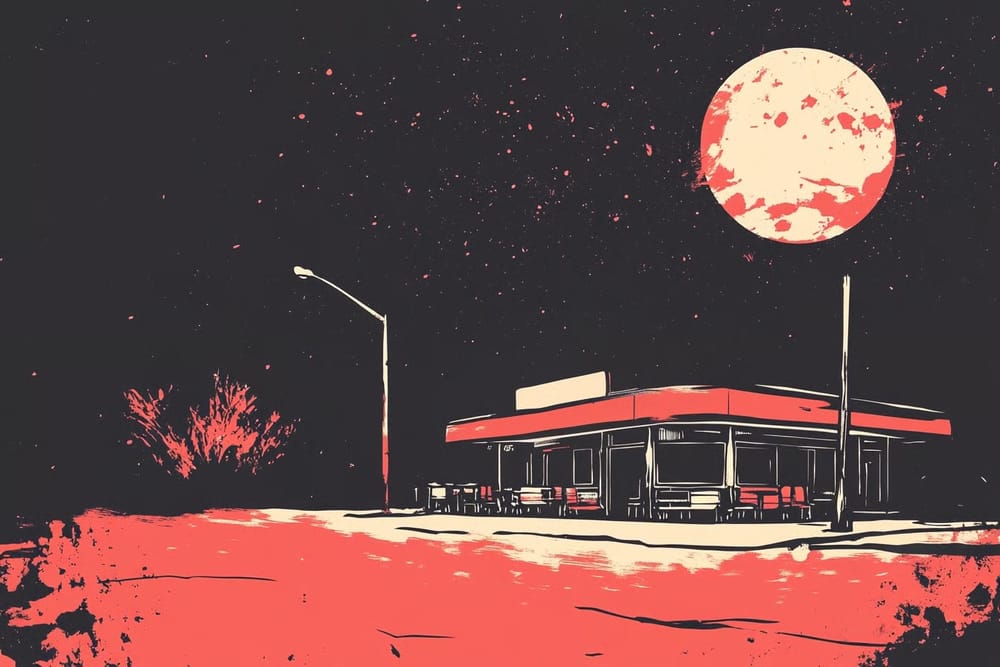
Randy's Diner
On the boy's screen, Mario jumped into a pit. Respawned at the same checkpoint. Jumped again.
"You've died twenty times on that part," the father said.
"Twenty-six."
"Try a different route."
"There's only one route, Dad. You just have to get the timing right."
The Garmin flickered and went black.
"Damn."
"What?"
"GPS died." He tapped the screen. Nothing. "Whatever. I know the way."
Every other Friday for three years. Four hours to Denver, four hours back. The same exits, the same rest stops, the same dead stretch where cell service dropped and the boy surfaced from his screen long enough to say one of four or five things.
The boy looked up from his Switch, face pale in its blue wash. "I'm hungry."
7:15 on the dashboard clock. Denver by six, he'd told the boy's mother. The road should have widened by now. More lanes, more light, the first billboards for ski resorts and personal injury lawyers. He'd driven this stretch enough to know it, and he did not know this stretch.
"We'll stop soon."
The road narrowed. Three lanes to two, two to one. No construction signs, no cones. Trees pressed in from both sides, branches locked above the road, pine closing the highway into a tunnel. The BMW's headlights clicked on.
A gap in the trees. Chrome and glass caught the last light.
"Oh, cool," the boy said. "A real diner."
RANDY'S DINER pulsed in soft neon. Pink-red, the color on the inside of your eyelids when you face the sun. A Sinclair station sat beside it, its green brontosaurus bleached to pale jade.
The father pulled into a lot half full of cars that belonged behind velvet rope. A mint-condition '57 Chevy, turquoise and white. A Hudson Hornet in deep maroon. Every panel held the wet sheen of metal that had never left a showroom.
"Car show?" the boy said.
No signs. No ropes. No one circling with a polishing cloth. The cars sat at casual angles, all empty.
"Must be."
Ding-ding.
Bacon grease and coffee hit them at the door. Red vinyl booths lined the windows, miniature jukeboxes bolted to every table. A long counter ran the length of the room, fixed stools in a row. Black and white checkered linoleum waxed deep enough to hold their reflections. Through a pass-through window, a cook in a paper hat worked the flattop in short, certain strokes.
Pancake batter on a hot griddle, sweet and thick. A burger spat and hissed on the flattop, building its crust. Onions caramelized somewhere out of sight.
A waitress crossed the floor. Blonde victory rolls, red lips, winged liner. Her white uniform carried the stiffness of cotton starched so many times it held its shape without her. Nametag: GLADYS.
"Two handsome fellas for supper?"
The boy grinned. The father's mouth pulled into the same shape before he caught it.
She led them to a booth by the window. The vinyl gave under them with a whoosh, warm, like a chair someone had just left. Menus landed, heavy, laminated. Burger: 65¢. Malted milk: 30¢.
"Will the missus be along, or just you two tonight?"
"Just us."
"Well, she's missing out." Gladys set down two glasses of water, ice clinking. "You fellas take your time."
The boy tilted the menu toward his father. "Is this for real?"
"Throwback pricing. They'll add a multiplier at the register."
"Still. Cool."
The boy ran his finger down the list, the pad of his thumb working the skin beside his index nail, pulling at it without looking. He set his Switch on the seat beside him.
Coffee arrived in white ceramic mugs heavy enough to anchor a boat. The father wrapped both hands around his and the heat sank through skin and found the bones of his fingers.
"I'll have the pancakes," the boy told Gladys. "Big stack."
"Excellent choice, sweetheart. And what can I fix for Dad?"
"Burger. Medium. Fries."
"Coming right up."
She crossed back to the counter. Her shoes made no sound on the linoleum.
Gladys set the plates down and the boy's pancakes threw a shadow across the table. Butter slid down the sides in slow golden trails. The burger filled the father's hands with a weight and a shape his palms recognized before his brain caught up: hand-formed patty, irregular at the edges, real American cheese melted into the grain of the meat, a bun with structural integrity.
"Oh my God," the boy said through his first bite. "These are incredible."
The father bit into his burger. His jaw stopped.
Pickle juice.
His father's trick. Pickle juice worked into the ground beef before forming the patties, a recipe the old man invented or stole and never told anyone. Twenty years the father spent chasing it. Different pickles, different beef, different ratios. Never close. His father went down in the kitchen on a Sunday in November, one hand on the counter and the other reaching for the spice rack, and the recipe went into the ground with him.
The father set the burger down. Picked it up. Took another bite. His eyes stung and he blinked hard and fixed on the window, the parking lot, the trees beyond.
"Good?" Gladys materialized. Coffee pot in her right hand.
"Perfect."
She topped off his mug without asking, the stream cutting off at the rim's curve. "You boys from around here?"
"Passing through. Denver."
Her hand stopped. One drop of coffee struck the saucer. Her pupils blew wide, irises contracting like a lens pulled to sudden focus. She stared past his shoulder, lips parted, and for two seconds the expression dropped from her face, and what showed through: skin pulled tight on a frame, the skull pressing at cheekbones and jaw.
She blinked. The smile returned. Her lips clamped tighter around it.
"Denver," she said. "That's quite a drive."
The father tracked her to a man at the counter, gray flannel suit, fedora resting brim-up beside his coffee. The man did not look up from his newspaper.
The father's eyes caught the dateline before the page settled flat.
June 15, 1957.
He scanned the room. In the corner booth, a teenage couple shared a milkshake, two straws in one tall glass, their foreheads so close a card wouldn't fit between them. The girl wore a letterman jacket three sizes too big. She laughed at something the boy said and covered her mouth with her fingers.
The father looked away. Looked back.
She laughed. Same laugh. Hand covering her mouth. The sleeve fell to the same point on her elbow, the fold landing in the same crease, at the same angle. The milkshake level held. The condensation held, each droplet fixed on the glass like beads set in resin.
At a middle booth, a little girl lifted a drumstick. Bit into it. Set it down. The meat sat whole. She lifted the drumstick. Bit the same spot, her teeth closing on unmarked skin. Set it down. Whole.
The man at the counter turned a page. The same page. Same wrist, same rustle, same angle of elbow settling on Formica. His cigarette balanced in a glass ashtray. The smoke climbed in a line so straight it looked ruled. The ash hadn't grown. The cigarette hadn't shortened.
The diner hummed. The father picked the strands apart.
"—Eisenhower's doing a fine job, if you ask me—"
"—that new Bel Air's a real beauty—"
He counted to thirty.
"—Eisenhower's doing a fine job, if you ask me—"
"—that new Bel Air's a real beauty—"
Same words. Same cadences. Same pauses. The father set his coffee down and opened his mouth.
"Now, who's saving room for pie?"
Gladys stood beside the booth. Three seconds ago she had been at the counter, refilling a water glass. Now she stood here, order pad against her hip, pencil behind her ear. The smile fixed at the same wattage as when she'd seated them.
"Can we get pie?" The boy's eyes locked on a rotating case near the register. "They have pie, Dad. In that spinning thing."
The father looked at his son. Syrup at the corner of his mouth. That grin. The booth held them in its warm vinyl grip and the jukebox played Sinatra and the boy hummed along three notes off key, and outside the lot the highway waited, and past the highway Denver waited, and past Denver the porch where a man's hand would rest on the small of his ex-wife's back while the father shook the other hand and smiled and said something about traffic, and then the four hours east, the parking garage, the ring dropping into the center console with a clink, the apartment, the two weeks until the next Friday when the ring went back on.
The pie case turned. Cherry, apple, lemon meringue. The meringue peaked in formations so precise they looked architectural.
He could order pie. He could sit in this neon warmth and let his son hum Sinatra wrong and taste that burger one more time.
"Always have pie, sweetheart." Gladys's smile pressed from the same die as the one at the entrance. Same millimeters of lip, same teeth, same crinkles at the corners, set in wax. "Cherry's fresh. Made it this morning."
"We need to go."
"Oh, don't rush off." Gladys set her hand on the table. Her nails shone in red ovals with no chips, no wear, no cuticle ridge. Nails that had never grown. "The highway gets so dark this time of night. So easy to get turned around."
"We have GPS."
The blue drained from her eyes like a screen losing its backlight. "GPS," she said. The letters came out of her mouth one at a time, like stones she was spitting into her palm. The color flooded back. "Well, whatever that is, the highway gets so dark this time of night. So easy to get turned around."
"Dad?" The boy looked between them.
"Check. Please."
"Stay for pie." Gladys leaned closer. Behind her the diner noise continued, the same loop of voices, the same clink of forks on plates where nothing moved. "Randy's cherry is famous clear to Grand Junction. Everyone stays for pie."
"We're leaving." The father stood. His thighs hit the table edge. Coffee sloshed over the rim and spread across the Formica.
Gladys did not step aside. She filled the aisle, order pad on her hip, the way a load-bearing wall fills a room.
"Randy makes the best pie. Been making it since..." Her hand rose to her temple, fingers pressing skin. A crease cut between her eyebrows. "When did we open? It feels like yesterday. It feels like forever. I can't..." Her fingers dug deeper. "The days all run together."
The jukebox skipped.
I've got you under my— I've got you under my— I've got you under my—
"Move."
Every head in the diner turned, smooth and simultaneous, like figures on a clock tower striking the hour. The teenage couple, the man at the counter, the family, the cook in the window. Their faces carried pleasant expressions. Their eyes carried nothing.
The boy's fork paused halfway to his mouth. He looked at the faces, then at his father, then back at his plate. He took the bite.
"Pie's on the house," Gladys said. "Everything's on the house if you stay."
The father pulled a twenty from his back pocket and dropped it on the table, on the spilled coffee.
Gladys lifted the bill. Held it between thumb and forefinger, at arm's length, the way you'd hold a photograph of someone you lost track of decades ago. She turned it over. Ran her thumb across the watermark. The security strip. The date.
She folded it once, twice, three times, and tucked it into her apron pocket, her fingers pressing the fabric flat.
"Thank you." A whisper.
Her hand closed around his wrist. Her grip ran warm. Her fingers pressed into the groove where his pulse lived, and her own pulse hammered back through the skin, quick and real.
"Get your boy out of here."
She released him. Straightened. Tugged the hem of her uniform, one sharp pull, and the smile snapped back and her voice carried to every corner.
"You folks drive safe now!"
The father grabbed the boy's arm. The grip he used in crowded airports, in parking lots.
"Dad, what—"
"Walk."
They walked. Past the counter, where the man turned his eternal page and the smoke climbed its plumb line. Past the family and their infinite fried chicken, the little girl mid-bite, the drumstick whole in her hand. Ten feet to the door. Five.
He looked back once.
Gladys stood behind the counter. She had crossed the room in four of his steps. Her hands pressed flat on the Formica, tendons standing in her wrists. The smile ran down her face like wet paint. Her eyes burned above it.
She mouthed two words.
Go. Please.
Outside, the air hit thin and cold. Pine resin and exhaust and nothing cooking, nothing warm. The father pulled a breath and it fell short and he pulled another.
Chirp. The BMW's headlights flashed. His right hand missed the door handle, caught it on the second grab. The metal bit into his palm, January-cold on a night in June.
They got in. The engine caught. The vents pushed air that smelled like leather and the boy's shampoo and nothing else.
Click. Click. Click. Click. All four locks.
"Dad?"
"Seatbelt."
He pulled out. Gravel popped under the tires like knuckles cracking. In the mirror, Randy's shrank. The neon pulsed pink-red, matching the rhythm in his chest. A white uniform filled the doorway. A hand swung side to side, the same arc, the same pause at each end.
The trees closed. The diner vanished behind pine.
"My Switch." The boy's hand shot to his empty pocket, patted the seat beside him. "I left it in the booth."
The father checked the rearview. Trees. Road. Dark so complete it looked solid, a substance poured between the trunks. No neon, no trace of pink-red light above the canopy.
"It's not there anymore."
"What? Just turn around."
"Look behind us. Tell me what you see."
The boy twisted in his seat, pressed his face against the rear window, fogged a circle on the glass with his breath. Ten seconds. Twenty.
When he turned back, the grin had died. He wore the face he'd worn the afternoon his mother told him about Denver, about the new house, about how it would be an adventure.
"My Switch," he said, and the words came out with no weight behind them.
The father reached across the console and put his hand on the boy's knee. The boy laid his own hand on top.
The GPS came alive.
Recalculating.
I-70. Forty-five minutes from Denver. The clock read 10:22 PM.
They had stopped at 7:15. Ate for thirty minutes at most. The father ran his tongue across his teeth and tasted pickle juice, his dead father's recipe. The boy's chin still shone sticky with syrup.
"Dad?"
The father's throat clicked.
"That was a real place, right?"
The GPS screen bled. Blue to black to static, then a red so deep it pushed through the glass, throbbing, alive.
RANDY'S DINER — 0.1 MILES
Thump.
His foot found the brake. The BMW shuddered, ABS stuttering, tires barking, the road surface shifting under them from asphalt to gravel, smooth to rough, the steering wheel jerking against his grip. The headlights swept pine trunks, then chrome.
The same lot. The same gravel. The turquoise Chevy, the Hudson Hornet. Not a tire's width of difference. The chrome threw their headlights back in flat white sheets.
Through the windows: the teenage couple, foreheads together, straws poised. The man at the counter, page half-turned, smoke climbing its plumb line. The cook in the window, spatula raised, frozen in bright light. No sound reached them through the glass.
Click. The boy's seatbelt released. "We're back. I can get my Switch."
The father's knuckles ridged white on the steering wheel. His wedding ring pressed into the flesh of his finger, the gold band he still wore everywhere except Denver. Every other Friday, somewhere past the last exit before the city, he worked it off and dropped it in the center console and arrived with a bare finger and shook the other man's hand and smiled and said something about traffic, and on the drive home he fished it out and slid it back on in the dark.
Through the glass, at their booth, Gladys stood with the coffee pot. The stream fell in a straight brown line. The mug beneath it did not fill.
Their plates sat where they'd left them. The burger bleeding a grease ring into white ceramic. The pancakes half-eaten, syrup suspended mid-drip, a golden thread hanging between the bottle and the stack.
The boy's Switch lay on the red vinyl seat, right where he'd left it, in the warmth.
She looked up. Through the window. She smiled. A new smile. The first one he believed.
The folded twenty in her apron.
The boy's hand closed around the door handle, his knuckles white against the chrome.
"Come on, Dad. Our food's getting cold."