
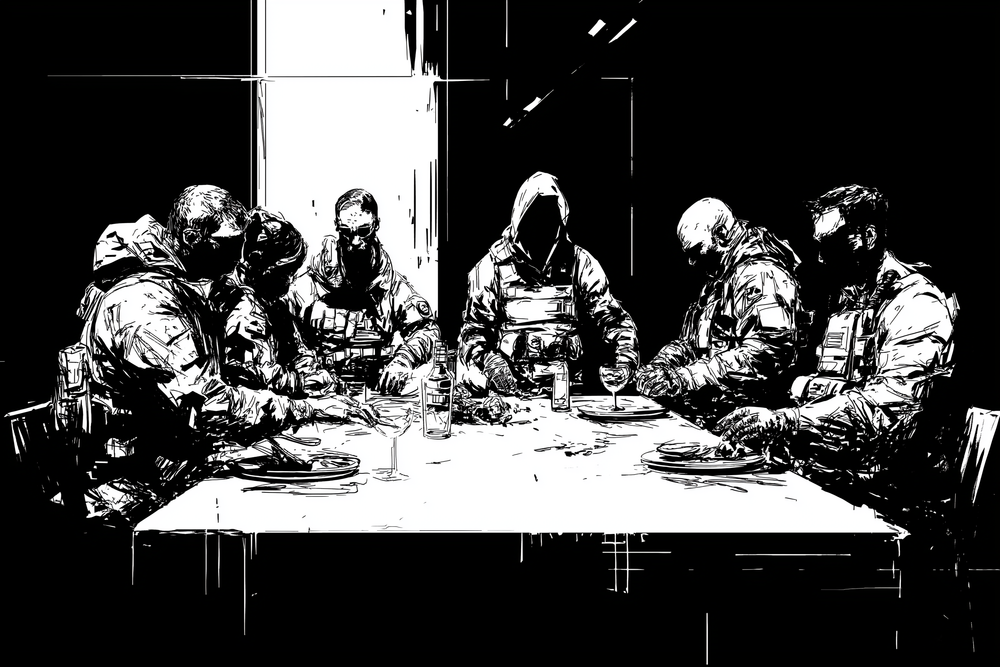
The Last Supper but After Dessert
Six men in a kitchen built for a magazine spread, and the fluorescent tubes turn all of us the same gray. Petrov scrapes the last of the crème brûlée from a ramekin with a teaspoon, ceramic clicking against porcelain, each beat the same, and the five of us watch him the way you watch a man defusing ordnance.
Kovács straightens the salt and pepper shakers until their labels face the same direction. He does this with everything. Since we entered the house fourteen hours ago, he has aligned the knife block with the edge of the counter, squared the dish towels on their rail, arranged the Beretta magazines in two parallel rows, their base plates flush. He sits with his back to the refrigerator, his rifle across his knees, and reaches over to nudge Petrov's ramekin a quarter inch left so it centers on the placemat.
Everything in its place. Everything level. Everything flush.
"Three bites left," he says.
Petrov looks at the spoon. Looks at the ramekin. Taps the edge twice and brings it to his mouth.
"Two," Kovács says.
"Let the man eat," Maguire says.
Kovács shrugs. "Two bites. Is fact."
Deck laughs from his spot by the window, where he tracks the searchlights through a gap in the plywood. His laugh sounds like a cough torn out of him sideways. "Ja, well, we're all counting down something, boet."
The spotlight sweeps through the gap. A white stripe crosses the ceiling and vanishes.
Suleiman pours tea from a pot he found in the pantry. Loose leaf. He boiled the water on a camp stove balanced on the marble countertop between a bread knife and two of the Berettas, and the kitchen smells like cardamom and gun oil. He fills seven cups and sets the seventh at the empty chair, the one none of us has touched since Pham took the stairwell round at 16:40.
"You understand," Suleiman says, lifting his cup with both hands, "in Amman, there is a shop. A man there, very old. He blends the tea himself. Each customer, he remembers what they take. This is his life's occupation. Forty years." He drinks. "We had a man like this once, you understand. A man who remembered everything."
"Had," Deck says. "Ja."
Maguire touches his left ear, thumb and forefinger pinching the lobe, rotating it. "Would you say the tea is worth the circumstances, Suleiman?"
Suleiman smiles with his eyes closed. "In a siege, all tea is excellent."
I catalogue the kitchen the way the brochure would. Sub-Zero refrigerator, Calacatta marble, Wolf range with six burners and a griddle. The griddle still carries egg residue from that morning. The owners ate breakfast fourteen hours ago, a Saturday, scrambled eggs on a twelve-thousand-dollar stove, and now the owners sit in a Holiday Inn conference room giving statements and we die in their kitchen, and this works out to a fair trade, a lateral move, the kind of swap you'd find in the classifieds if the classifieds covered this particular market segment.
Yun checks the magazine in his sidearm, ejects it, counts the rounds with his thumb, reinserts it. Fifteen rounds, nine-millimeter. He hums four notes of a song I can't place.
"Six hours," Kovács says. He straightens a fork that has drifted out of alignment on the counter. "Six hours since last communication."
Everything in its place. The fork lines up with the knife.
"And when they come," Maguire says, pinching his ear, "would you say they'll use the front?"
Kovács looks at him. "You already know."
"I'd like to hear you say it."
"Then you will wait."
Deck peels back the plywood an inch. Cold air rolls through, March air, the kind that carries sound. Diesel generators running the spotlights. The thrum of a helicopter holding position to the north. Voices, indistinct, amplified through a bullhorn into the adults from a Peanuts cartoon.
"They're saying we should think about our families," Deck says. He lets the plywood snap back. "Ja, nee, that's rich. My family. My family consists of a cat named Bliksem who shits on my neighbor's car, and the neighbor, Hennie, who writes me letters about it. Formal letters. With letterhead. He had letterhead printed. For cat shit complaints."
"Is good cat," Petrov says. He sets the ramekin down. Empty.
Kovács takes the ramekin and stacks it on the other five, aligning their rims, then lays the teaspoon across the top at a precise perpendicular.
Everything in its place. Even the empty things.
Petrov smiles. Gold crown on his upper left canine catching the fluorescent light, a small flash like a signal from a distant ship. "Is good dessert. Is good last dessert."
"Don't call it that," Maguire says.
"Why. Is truth."
"You'd find," Maguire says, "that naming a thing can make it arrive faster. My grandmother said that."
"Your grandmother," Deck says, "also said the banshee visited every Tuesday."
"She did."
"And did it?"
"Tuesdays were bad days in our house. Draw your own conclusions."
Suleiman refills his cup. "There is a story. A merchant in Baghdad sends his servant to the marketplace. The servant comes back, pale, shaking. He says: I saw Death in the marketplace, and Death made a threatening gesture at me. The servant begs for a horse to ride to Samarra, where Death will never find him. The merchant lends the horse. Later, the merchant goes to the marketplace himself. He finds Death and asks: why did you make a threatening gesture at my servant? And Death says: that was not a threatening gesture. It was a gesture of surprise. I was surprised to see him in Baghdad, because I have an appointment with him tonight. In Samarra."
No one speaks. The helicopter shifts position. Its rotors chop the air into a pulse you could set a watch to.
"You understand," Suleiman says. "We rode to Samarra. All of us."
Yun hums.
I open the Sub-Zero. The owners left a wheel of brie, a jar of Calabrian chili crisp, half a roast chicken in cling film, a bottle of Sauvignon Blanc with two glasses left in it. The chicken carries a sell-by sticker: March 14. Two days past. I peel the sticker off, fold it in half, press the crease with my thumbnail. I do this with every sticker. Hotel key cards, luggage tags, rental agreements. Boarding passes in Bogotá, customs stamps in Ankara, intake forms in the building in Virginia. Fold the crease and file the paper and the transaction closes. I pull the chicken out and set it on the counter beside the Berettas.
"Chicken," I say.
Deck looks over. "You're joking."
"The chicken isn't."
Kovács stands. "Four pieces dark meat. Two breast sections. One wing." He glances at the empty chair. "Six men. Seven pieces." He pulls the wing free, sets it on a plate, turns the plate until the wing points toward twelve o'clock.
"Leave the extra for Pham," Suleiman says.
So we do. Suleiman sets a drumstick on a plate and places it at the empty chair and none of us says a word about Pham's body under the bedsheet in the upstairs hallway. The drumstick sits on the plate like an offering at a temple door.
Maguire eats standing, one hand on his rifle, the other tearing meat from a breast piece. "Would you say," he says, chewing, "that this changes the name of it? The last supper but after dessert, is that what we're calling this?"
"Is second supper," Petrov says. "In my country, we have name for this. Vtora vecherya. When the table is already cleared and someone brings more food. It means the night is refusing to end."
"The night's going to end," Deck says.
Nobody argues with him.
"Ja," Deck says again, quieter. "Ja, it will."
I bite into the wing. Two days past sell-by. The chicken tastes the same as the chicken in the break room of the building in Virginia, the same gelatinous skin, the same vaguely apologetic flavor. Nine countries, three continents, and the chicken never changes.
Kovács eats, stripping meat from bone with his incisors in neat rows, the bone left clean as something excavated. When he finishes, he places the bone parallel to his knife, adjusts it, adjusts it again.
Everything in its place. Even the bones.
A radio crackles. Not ours. The one we took from the advance team member who breached the back door four hours ago and made it six feet into the mudroom before Yun put two rounds center mass. The dead man's radio sits on the counter between the camp stove and the chili crisp, and every few minutes someone on the other end says a call sign and waits for a response that will never come.
"They will figure it out," Kovács says. He aligns the radio with the edge of the counter. "That he is not responding. They will adjust."
Suleiman drains his tea. "Then let us have this night."
"What's left of it," Deck says.
"What is left is everything."
Deck looks at him. The searchlight sweeps through the gap again, and in that stripe of white, Deck's face looks carved from teak left out in weather. His scars, three parallel lines from the right temple to the jaw, catch the light like grooves in a record.
"You're a poet, Suleiman. You know that?"
"I am a man drinking tea. If that is poetry, the fault lies with the century."
I unwrap the brie. Soft, room temperature, the rind splitting where my thumb presses. I spread it on a cracker from a cabinet above the Wolf range, a water cracker, the brand with the blue box that costs six dollars for a sleeve of pressed cardboard. The brie tastes like what money tastes like when money has taste.
The alarm systems.
This house runs Vivint. We disabled it at 06:00 when we entered through the garage. The owners were still in bed. The husband came downstairs in his bathrobe at 06:12, a Saturday morning, and he saw Kovács in his kitchen, holding a rifle, and the husband said, "Oh." Just that. Oh. Like he'd opened the wrong door at a hotel. And then he saw the rest of us, and his face did a thing it had never done before, and Kovács said "Upstairs" and the man went upstairs and gathered his wife and his two children, a boy and a girl, eight and eleven, and Kovács walked them to the garage and put them in the Lexus and Suleiman opened the garage door and they drove away.
We let them drive away.
The four other houses on the cul-de-sac, we did not.
Yun hums. Four notes. The same four notes. He catches me looking and stops.
"What song is that," I say.
He ejects the magazine. Counts the rounds. Reinserts. "My daughter's song," he says. "She made it up. Four notes. She was three."
"Was," I say.
Yun looks at the dark window. "She is nine now. She lives with her mother in Busan."
He hums the four notes again.
Petrov picks up the dead man's radio and turns it over in his hands the way a child turns a toy found in the street. He presses the talk button, holds it three seconds, releases. On the other end, someone says a call sign. Petrov presses the button again.
"Hello," he says. "Is Petrov. Your friend is dead, I am sorry. He entered the wrong house. Is wrong house for entering. Is good night, though. We have tea. We have chicken. You should come in and have some."
Suleiman closes his eyes.
"Is joke," Petrov says, releasing the button. "Is good joke."
"Petrov," Maguire says. "You've just given them voice confirmation that at least one of us is still alive and functional."
"They know this."
"You'd find that there's a difference between knowing and confirming."
"Is same."
"It isn't."
"Is same in Bulgaria."
Deck laughs his torn-out laugh. "Ja, well, in South Africa we have a saying: moenie die pot roer nie. Don't stir the pot."
"The pot," Kovács says, "is already stirred." He moves the salt shaker a quarter inch to the left.
The radio crackles. A different voice this time. Deeper. Someone with rank. The voice says, very clearly, in English: "We know what you did on Alder Court."
No one moves.
Alder Court. The cul-de-sac. This cul-de-sac.
"We have the security footage from the Novak residence," the voice says. "All four houses. We have everything."
Suleiman sets his cup down with extreme care, positioning it in the exact center of its saucer. His hands do not shake. "You understand," he says, to no one, to all of us, "the merchant's servant rode to Samarra. But the story never tells you what the merchant did. After Death confirmed the appointment. The merchant knew his servant would die. He went home. He had dinner."
"Is second supper," Petrov says.
The brie softens on my tongue. The cracker splinters between my teeth. Outside, the helicopter adjusts, the thrum of the rotors shifting pitch, and through the gap in the plywood the first gray suggestion of dawn lines the eastern trees, and Deck chambers a round and grins, his scars catching light, and Yun hums those four notes, his daughter's song, and Suleiman pours himself more tea.
I peel the sell-by sticker off the Calacatta marble where it left a residue. Fold it in half again. Press the crease.
Kovács straightens the fork beside Pham's plate, lines the knife parallel to it, squares the napkin. Everything in its place. Even the plate for the dead. On the chair, the drumstick sits untouched, its grease beginning to congeal in the cold kitchen light, and the radio voice says, "Alder Court, four houses, sixteen people," and Kovács moves a seventh cup into the row with the other six, spacing them all at equal intervals, and says, "Seventeen," and Maguire pinches his ear and Petrov says, "Is good," and the light in the east grows, and I pick up my rifle.
Dream City and Other Stories
Dream City and Other Stories collects forty-two stories like this one. Some of them are worse.