
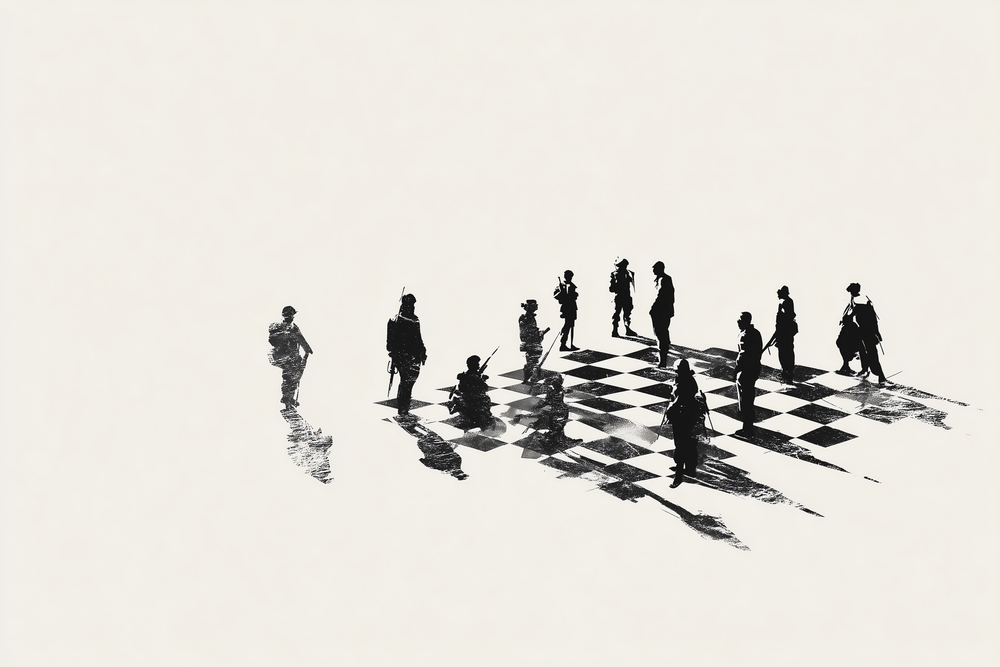
Zugzwang
The knight goes here. Two up, one over. Or one up, two over. An L-shape, like a hook.
Simon sets the black knight on e4 and waits. His son's fingers hover above the board, tongue pinned to the corner of his mouth, left foot drumming the chair leg. The chess clock reads 4:45 on Leo's side. Late afternoon light cuts through the blinds in white slats across the carpet. Outside, the neighbor's sprinkler kicks on. Tch-tch-tch-tch-tch.
Leo's room holds the smell of grape Pedialyte and new-sneaker rubber. A shoebox on the dresser, size 2, blue with silver stripes, unopened for three weeks because Leo mentions the trip to see Grandpa once a day, minimum. Yesterday he said it in the bathtub, suds on his chin like a beard, and Simon's hand tightened on the shampoo bottle until the plastic cracked down the seam and neither of them mentioned it.
Eight weeks ago, Simon typed his father's name into a search engine. Bernard Cole chess. Tournament results, rankings, the residue of a competitive life. The fourth result linked to a PDF from the Maricopa County Superior Court.
He read all twenty-three pages at 2 AM, the desk lamp throwing a cone of yellow across the keyboard, Rebecca's white noise machine humming through the wall on its Ocean setting. His left hand gripped the edge of the desk hard enough to press the wood grain into his palm. Behind his sternum, a fist closed and did not open.
The names hid behind thick black bars. The dates did not. Phoenix, 1986. Tempe, 1988. Mesa, 1991. The plaintiffs listed by age. Eleven. Twelve. Thirteen.
Page nine described a study. Leather wingback chairs. A crystal decanter on the sideboard. A hand on the back of the neck.
The case died on statute of limitations. The judge signed his name.
Simon closed the browser, opened it, closed it, read page nine again. He pressed both hands flat against the bathroom mirror. Bernard's jaw met him there. Bernard's brow. The same hands, long fingers spread against the glass, built for lifting pieces from the crown.
He ran the faucet cold and cupped water to his face. The porcelain edge of the sink left a white ridge across his palms that lasted until morning.
"Dad."
"Take your time."
Leo's hand floats toward his queen. Stops. Floats toward his bishop. His lower lip disappears between his teeth. The clock ticks. 4:31.
Simon's phone vibrates against his thigh.
He learned chess in that same study. Late sun through Bernard's curtains turning the Laphroaig to amber in its crystal decanter, the level sinking between sessions. Pipe tobacco and Dunhill cologne thickening the warm air. Leather wingback chairs. Bernard's hands, enormous, adjusting pieces with the fingertips only, the way he insisted: thumb and index finger, lift from the crown, never drag.
Bernard's hand on the back of Simon's neck when he made a good move. The squeeze. The thumb pressing the vertebra at the base of the skull.
Simon sat in those chairs at seven. The same age.
Condensation wets his palm when he lifts the water glass. He drinks and sets it down on the cork coaster.
"What if I move my rook?" Leo says.
"Then what happens?"
Leo traces the diagonal with his eyes. Afternoon light catches the white scar above his left eyebrow.
"Then your bishop takes it."
"And then?"
Leo's forehead folds. His chin pulls down.
"I don't know," Leo says.
"That's okay. Look at the whole board."
The whole board carried Bernard's voice in it. Bernard's study. Bernard's hands adjusting pieces while boys sat across from him in leather wingback chairs. Boys listed by age on white bond. Eleven. Twelve. Thirteen. Boys whose mothers packed them lunches and drove them home and thanked Bernard for his generosity with their futures.
"Dad, what's that word again? The German one?"
"Zugzwang."
Leo mouths it. Zoog-zwong. He grins.
"It's when you have to move," Simon says, "but every move makes things worse."
"That's not fair."
"No."
"So what do you do?"
Simon turns the water glass on its coaster. A quarter rotation. The condensation ring widens on the cork.
"You move," he says.
Leo stares. The clock ticks. 3:58.
"That's a dumb game," Leo says.
"You wanted to learn."
"You said Grandpa taught you."
"He did."
"Is Grandpa good?"
The sprinkler outside continues its arc. Tch-tch-tch-tch. Stop. Silence. Then the chunk of the system resetting, water pressure rebuilding in the pipes.
"Grandpa was very good," Simon says.
Leo nods like this settles the question. He lifts his knight to his face, one eye squinted shut. The horse's carved mane, dark wood worn smooth along the neck from decades of handling. The little ears.
"He said he'd teach me too. When we visit."
"I know."
"He said he has a special chess set for me. From Budapest."
Simon's hand grips the table edge. Tendons surface in his wrist and vanish.
"He told you that?"
"On the phone. Mom let me call last Tuesday."
Last Tuesday, Simon came home from the office to find Rebecca at the kitchen island chopping bell peppers, evening light from the window above the sink turning the cutting board amber. The knife working in that fast, even rhythm she falls into when she's already decided what she won't discuss. He kissed her on the temple. She tilted her head away. Half an inch. The blade kept moving.
Four days ago, Simon sat in a rental car outside a police station in Scottsdale for forty-seven minutes with the engine running. Desert light flattening the beige stucco, an American flag limp against its pole. He drove to the airport, returned the car with a full tank, bought a Cinnabon at Gate B7 for Leo and ate it himself standing at a trash can outside the men's room.
"Mom said Grandpa's really sick."
"He is."
"Can they fix it?"
Simon reaches across and straightens Leo's remaining knight, the white one, tilting left since Leo knocked it during his last move. He centers it on the square. Thumb and index finger on the crown.
"Sometimes they can," he says.
Leo watches Simon's hands. The way the fingers curl around the bishop's mitre.
"I want to go see him," Leo says.
"I know, buddy."
"You keep saying that."
The clock ticks. 3:22.
Simon's mother sends three messages a day and signs each one Diane, as if the phone doesn't display her name and photograph on the screen.
He keeps asking for Leo. The doctors say maybe a week. Maybe less. He says he has something for him. Please, Simon. I don't understand what's happening. Just come. Diane.
Diane, who played bridge in the next room during every lesson. Diane, who packed the boys sandwiches. Crustless. Cut diagonal.
"Your move, Dad."
Simon looks at the board. Leo's queen holds d5. Exposed, but controlling the center, because Simon taught him to seize the center, because Bernard taught Simon: control the middle and everything else follows.
In three moves, Simon can end it. The knight, the bishop, the quiet lateral slide of the rook. The kindest checkmate arrives before the opponent understands what happened. Bernard said this in the study, adjusting the decanter's stopper, the crystal grinding against the rim. Tsss.
Simon locks the phone screen and sets it face-down on the carpet beside his chair. Leo picked out the blue case, a cartoon rocket on the back.
"Dad, are you okay?"
"I'm thinking."
"About the game?"
"About the game."
Leo pulls his feet up onto the chair, knees to his chest, arms wrapped around his shins.
Simon picks up his rook. Slides it one square to the left. A wasted move that gives away nothing and gains nothing, that keeps the game alive on a board where the outcome already sits determined.
"Oh," Leo says. He unfolds. Leans forward. Plants both hands flat on the table, shoulders rising near his ears. "Oh. Oh."
Leo grabs his bishop. Slides it to f3.
A terrible move. It exposes his king and sacrifices his last defense for an attack that leads nowhere.
Leo sets the piece down. His jaw squares. His chin lifts.
Simon keeps a photograph in a shoebox in the hall closet. Bernard Cole, twenty-six, at a tournament table in Amsterdam, 1974. The jaw squared in this way. The chin at this angle.
Leo grins.
"Your turn," he says.
The clock reads 2:14. The blue sneakers wait on the dresser, laces still factory-tied. On the floor, Simon's phone glows once through the case, then goes dark.
Simon looks at his son's face. He looks at the board. He picks up the knight.
Tch-tch-tch-tch-tch.
Dead Men and Other Stories
This short story is part of my compilation of short stories, Dead Men Talk and Other Stories.