Fell
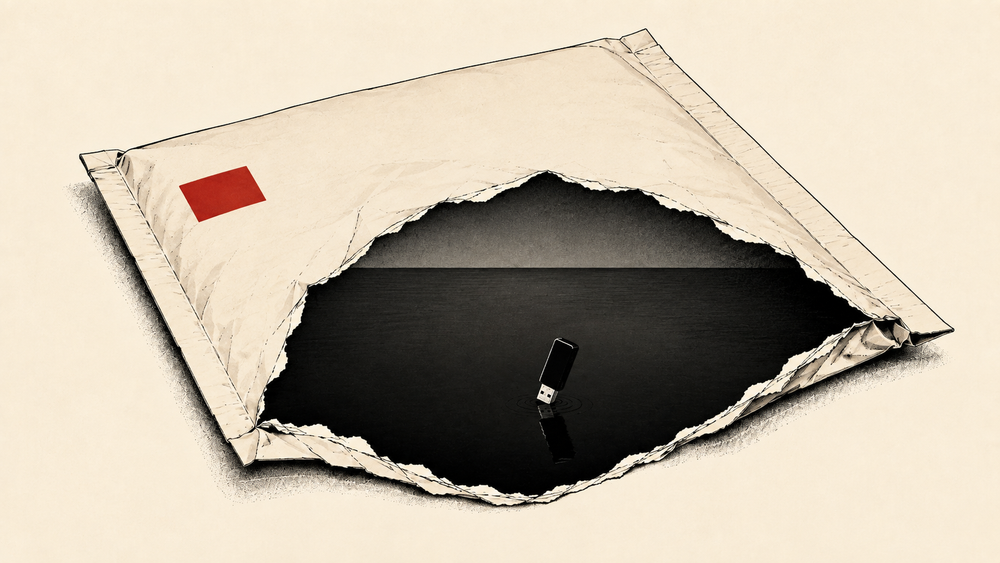
A courier signs his own name so he can carry somebody else's. At 135 South LaSalle, Oren Fell drives the pen through the manifest until OREN FELL ghosts the bottom sheet. The receptionist keeps both hands on the padded envelope. Something inside slides against the paper. A name can cross an ocean without a passport, survive a bullet, and fit inside a messenger bag. She pushes the envelope across the granite.
"Lincoln Park," she says. "The address is on the label."
He clips the envelope into his messenger bag, cinches the strap across his chest. The envelope weighs less than most. Whatever it holds shifts when he moves, a slight lateral slide, a small solid object loose in padding.
"Signature's light," the receptionist says, her eyes on the manifest, on the carbon copy she tears free with a sound like a Band-Aid pulled from dry skin. She files it in a drawer. "Dispatch has your route."
Oren does not need it. He has ridden this grid through three winters. He knows where the wind funnels between buildings on Clark, where the sidewalk grates blow steam that fogs his glasses for a count of two pedal strokes before the cold eats it. He knows the grid the way he once knew the streets of Ramadi, by the feeling in his hands when a turn went wrong. In Ramadi his hands would tighten on the rifle's pistol grip before his mind registered the doorway, the shape in the window.
On a fixed-gear, you cannot coast.
The pedals connect directly to the rear wheel through a single cog, no freewheel, no clutch, no ratchet mechanism to let the wheel spin independent of the legs. If the wheel turns, the legs turn. If the legs stop, the wheel stops. To slow down, you resist the pedals, pushing back against the rotation, which means slowing down on a fixed-gear is a negotiation between your quadriceps and the momentum of your own body.
Outside, the wind comes down LaSalle from the north, channeled between buildings that compress the air into a corridor, the Board of Trade visible at the south end as a flat gray slab, its art deco crown dissolved in cloud cover. The temperature makes metal contract. Oren can feel it in the brake lever under his left hand, the steel shrinking against the cable housing, the cable itself stiffening inside its sheath the way a vein stiffens when the blood thickens. His front brake is his only cable brake. On a fixed-gear, the rear brake is your legs.
He pulls his balaclava up over his nose. Neoprene gloves, two layers, the inner pair wool, the outer pair windproof with silicone grip pads already losing tack in the cold, the polymer chains tightening, the surface hardening from gel to plastic. Insulated cycling shoes with neoprene covers zipped over the toe box. A soft-shell jacket over a merino base layer that wicks moisture off the skin and into the middle layer, where the moisture will freeze. None of this will matter before he reaches Lincoln Park.
He clips in. The cleat snaps into the pedal. He pushes off from the curb, north on LaSalle, into the wind.
The cold enters through his eyes first. The tear ducts produce fluid to protect the corneas, and the fluid freezes on his lower lashes before the blink cycle can clear it. His eyelashes carry beads of ice that fracture the city into prismatic shards each time he blinks. His nostrils seal shut on the inhale and he breathes through his mouth, through the balaclava, the neoprene turning wet and then stiff and then wet again in a cycle that matches his breathing.