Scraped Again
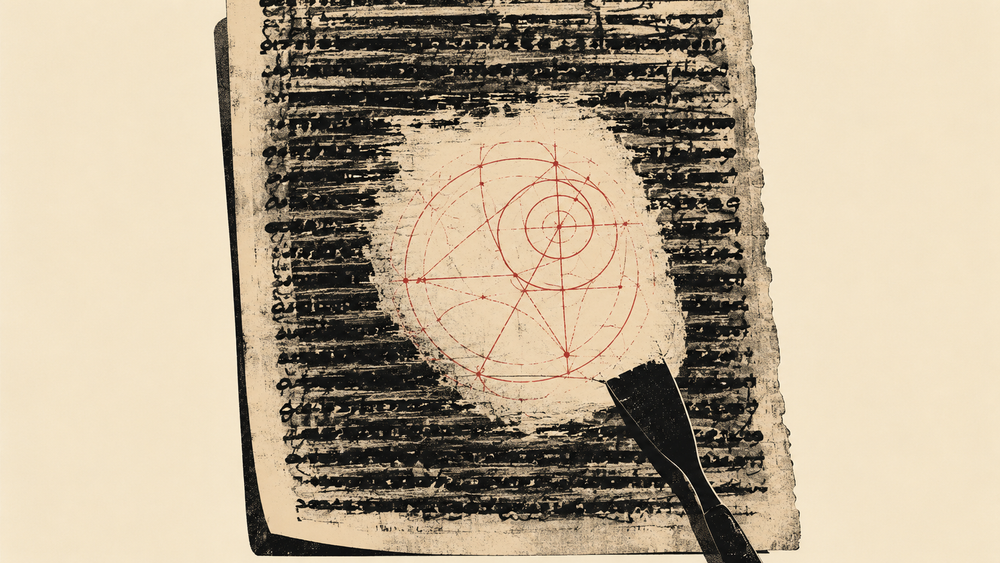
In April of 1229, in Jerusalem, a priest named Johannes Myronas needed parchment and had none. He had a library instead, and in the library sat books nobody had opened in years. He picked one, a Greek manuscript three centuries old, its pages crowded with diagrams, circles cut by chords, spirals, columns of reasoning in a small brown hand. He unbound it. He washed the ink loose and scraped away whatever held on. Then he folded each leaf in half, turned it ninety degrees, and wrote a prayer book across the grain of the old text. On the first page he signed his name and the date, the way a workman signs a finished job.
The book he took apart held the only copy on earth of The Method of Mechanical Theorems, where Archimedes reasons with infinity itself, running arguments a modern reader can follow into the opening moves of integral calculus. It held the only Greek text of On Floating Bodies. It held the Stomachion, a treatise on a fourteen-piece puzzle whose solutions number 17,152, a count that puts Archimedes at the front door of combinatorics, the branch of mathematics modern computing runs on. This was the man who measured the universe in grains of sand. Myronas washed him off the page and wrote prayers for the dead where the mathematics of infinity had been.
Historians treat that April as a crime scene, and the story pulls the same grief out of nearly everyone who hears it. A monk raised a knife, and the greatest mathematics of the ancient world went dark under his hand. I held the same instinct for years, and I aimed it at myself, which is the part of this story I will get to.
First comes the fact the crime scene hides. Two other copies of Archimedes existed when Myronas picked up his knife. Scholars know them as Codex A and Codex B. Both sat in libraries under Archimedes' name, and Renaissance translators worked from them. Nobody scraped a single page of either. Codex B drops out of the record after 1311. Codex A drops out of the record after the 1560s. The two books everyone protected slid out of the world without a mark, and the one book somebody gutted for its skin crossed seven more centuries. Will Noel, the curator who later ran the recovery project, put the whole paradox in six words: "It survived because it was used." Monks at the Mar Saba monastery read those prayers for hundreds of years. They handled the book, repaired it, dripped candle wax on it, carried it. The deepest mathematics of the ancient world rode through the Crusades and the Ottoman centuries hidden inside an object that people needed every day.
The book has a name for what it is. The word palimpsest comes from the Greek palin and psestos: scraped again. The "again" carries the secret. Parchment starts as the skin of an animal, and the skin becomes a page only after workers soak it in lime and scrape it clean, hair off one side, flesh off the other. So the page Myronas scraped had been scraped once already, to become a page at all. His was the second cut. The 'again' is literal.
The layers kept coming. In 1906 a Danish scholar named Johan Heiberg found the prayer book in a church library in Constantinople, saw faint Greek geometry showing through the prayers, and spent a summer reading what he could with a magnifying glass. Then the book vanished into the twentieth century. It sat in a Paris cellar while mold ate at its margins. At some point a dealer, to raise the price, painted gold portraits of the Evangelists over four of its pages: fake Byzantine saints on top of real Byzantine prayers on top of real Greek theorems. In October 1998 the book sold at Christie's for two million dollars to an anonymous American, who deposited it at the Walters Art Museum in Baltimore and funded a team of scientists to spend a decade taking the layers apart with light. The pages the mold and the forger had ruined went to the Stanford synchrotron, where an X-ray beam the width of a human hair crossed the skin inch by inch. The medieval ink carried iron. The knife had taken the surface of the page, and the iron had gone deeper than the knife. Wherever a letter had ever stood, the beam found iron, and the iron answered, and the erased words came back one letter at a time after almost eight hundred years.
Now the part about aiming the instinct at myself. For more than a decade I ran a blog, and on that blog I wrote about souls. I wrote about darkness and dreams and the fire inside. I paced my sentences with ellipses the way a smoker paces a day with cigarettes. I closed post after post by telling strangers to never give up, and the strangers arrived in numbers I quoted at parties. Then my taste outgrew my archive, which happens to everyone whose taste stays alive, and one day I read my own posts the way historians read Myronas: as a crime scene. I wanted it gone. When I built the site that carries these words, I built it the way a man builds after a fire. The old one came down. Clean vellum, I told myself, and by now you know what I think of clean vellum.
The old voice bleeds through anyway. My sentences still reach for uplift in their last three words, and I bend them back the way you bend a warped board. Readers still arrive who found me in the soul-and-darkness years, and I have stopped flinching when they mention it, because a decade of overwrought posts trained the hand that bends the board. The prayers stood on the theorems, and the theorems reached 1998 riding under the prayers, and the rescue ran in both directions at once. My old writing holds up my current writing the same way. Scrape as hard as I like, the iron sits in the skin.
Everybody owns an era they would pay to scrape: the posts they wrote at nineteen, the business that failed in public, the marriage, the years of quoting hustle gurus, the version of themselves that performed at full volume for an audience they no longer want. A whole industry now sells the scraping. Delete your history, rebrand, relocate, start clean. The parchment offers two corrections. The first correction says the knife only ever takes the surface, and whatever you pressed hard enough to matter has already sunk past where any knife can reach. The second correction matters more. The self you refuse to overwrite, the one you laminate and guard and never risk in daily use, follows Codex A and Codex B out of the world. Vault a thing and it vanishes. The only version of you that crosses the centuries, or even the decade, is the one in circulation, written over and over, scraped again and again, needed by somebody every morning.
I keep a private proof of this. The manuscripts I guarded for years, the ones too good to risk, sit in a drawer doing what guarded things do. The stories I dragged into public every week, flawed and overwritten, built everything you are reading now.
I have stopped mourning that April. Myronas needed the skin, and the mind he scraped off it sank into the grain and waited. In Baltimore a beam the width of a hair crossed the ruined page. Wherever the old hand had borne down, the iron answered the light. Archimedes came up out of his own erasure, one letter at a time.