
Everything Looks Like a Book
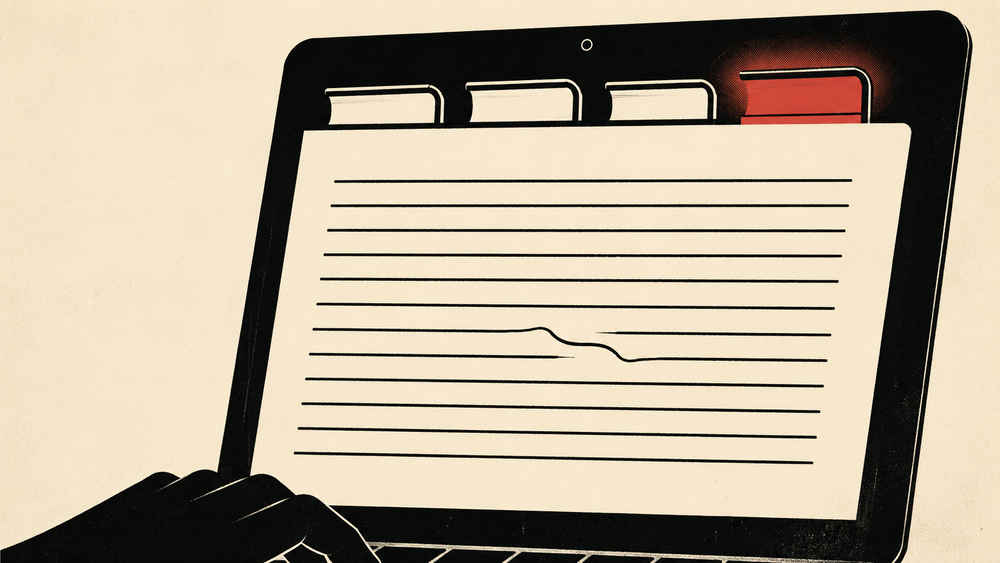
The work goes wrong about three sentences from the end of a paragraph, and my hand starts moving before I decide to. It climbs to the top of the screen, where four books wait in four tabs, and it opens a different one. Up there sits a book I have not yet failed, and from across the screen it glows. The book in front of me glowed too, a month ago. They all glow until you sit in one long enough to find the crack.
I work inside Vellum, which dresses a manuscript as a finished book while you write it. The margins land where a real book's margins land. The drop caps bloom at the chapter heads. It will frame the same page inside a Kindle, an iPhone, a paperback, any reader I pick, so the broken half-thing under my fingers wears the clothes of the book I meant to make. Everything looks like a book in here. Everything looks like a book before it is one, on this screen and inside your head.
Today the lit tab holds In a World of Gods and Monsters. I owe it a final edit on Episode 2 and a first draft of Episodes 3 and 4. I open it and read a paragraph I wrote last week. One sentence in the middle reads like a finger sewn back on at the wrong angle, the knuckle there but pointing off true. I push a word, swap a word, put the first word back. The sentence stays crooked. A whole book can die in the space of one line that will not sit down right.
The other tabs hold an SF novel called The Extinction Club, a novel about Bram Stoker writing Dracula, and a novella called Believable Buff, where a husband and wife rob banks together. Every one of them glowed once. Every one of them held the lit tab, the book I had sworn to finish, until it reached the place where the idea stops doing the lifting. A plot hole opens that will cost a week of staring to close. A line lands wrong, and no word I try lands it right, and the wrongness leaks into the lines on either side. Right there, the next tab starts to glow. The newest book glows because I have not yet asked it for anything. An idea you have not worked is a stranger you have not argued with yet.
Nobody likes to say the next part out loud. Imagination is cheap. We dress it up because it feels like proof that we were chosen, but strip the robe off and you find a good memory at play. You carry a junk drawer of overheard lines and half-forgotten faces, and the back of your mind paws through it while you do the dishes, and now and then it presses two unrelated things together and hands you a third that did not exist a second ago. The whole trick lives there. Every writer owns it. So does every person who will never write a word. The gift is common. The grind is rare.
On the good days the trick runs hot. I have drafted and cut in one pass, watched seven thousand words pile up between morning and dark, the sentences arriving faster than my doubt could catch them. Those days feel like flight. They feel like the reason I started. And they hand me the cheapest pages the book will ever hold, because the easy part was going to arrive no matter what I did.
The picture we all carry shows a writer struck by lightning while the muse pours a finished book through his hands, the whole thing, start to last page. It makes a pretty poster. It also gets the order of the work backward. The lightning writes the easy first third, the part that arrives on its own. Will writes the rest, the two-thirds you drag onto the page yourself.
A writer who only ever starts performs a verb. He is writing, present tense, on a random Monday, and it feels wonderful. The noun goes to someone else. The noun goes to the one who came back to the crooked sentence on Wednesday, and Thursday, and the gray Sunday when the heat had drained out of the idea and the glow had jumped to another tab, and bent the line straight anyway. Finishing is the second half of the job, and the second half wears no costume. The thing that stood like a cathedral in your head shows up on the page as a heap of wet stone, and you carry it up one block at a time, in the rain. Even the ideas I swore were untouchable came up as rubble, and every one of them made me do the lifting. Inspiration buys the first thrill. The book gets built by the one who keeps hitting the keys after the thrill walks out.
Someone will hold up the books that came without a fight. I wrote Jazz in two weeks. The whole thing arrived in one long fever, and I have spent the years since waiting for the fever to return on command. It does not. The muse is real. She visits. Once or twice in a writing life she sets a finished book in your lap and asks for nothing, and you spend the rest of that life mistaking her gift for your method.
Walk the shelf of books I have finished. One of them is Jazz, the two-week miracle. The rest I dragged out of myself on the days the fever stayed home. The gift built almost none of them. Showing up built the rest. A writer who waits for inspiration to strike twice writes one good book and then waits, and the waiting looks a great deal like a career until he notices the shelf has stopped filling.
So I go back to the tab I ran from. The sentence is still crooked. Gods and Monsters still owes me Episode 2 and two more behind it. The other books still glow along the top of the screen, and by now I have learned what the glow is made of. The glow is the light coming off the part I have not done yet. Every tab loses it the second I sit down and stay.
Here is the one thing the good days never taught me, the thing I have to learn again at every crooked sentence. The pleasure I kept chasing into the next book had been sitting in this one the whole time. It was in last night's hour at the desk, my spine bent over the keys, working a single line until it gave with a small ugly click. No lightning hit. My hands did all of it, and I finished the page. Nobody prints a poster of a man who got struck by nothing and bent one sentence until it stood. The fun was in the work.