Blood Drive
Stage 4 sits at the ass-end of Sunset Gower Studios. You reach it by walking past the dumpsters where the caterers from Stage 1 throw out the salmon nobody eats, and past the parking structure where two assistant directors got caught doing lines off the hood of a Camaro in '84. The lot rents Stage 4 to productions that pay cash by the week, and nobody asks them about SAG cards or completion bonds.
It is October 1986. The Santa Anas shove desert grit through the seals on the loading dock, and the grit coats your jeans and works into the creases of your palms. Inside, the air tastes of Merit Lights and a Mr. Coffee pot nobody has rinsed since call.
You're here for the $180 a day. The $180 covers rent on a single in Van Nuys, gas for a '78 Datsun that needs a transmission, and the yellow pills a farmacia in Tijuana sells as Valium. The pills do the job if you take them two at a time. Since you told a first AD on a Cannon picture that he'd parked his generator so close to set you could hear it in every take, this is what steady work looks like. He told you to go fuck yourself and your ears and your future in this industry. You went and fucked all three.
The picture is called Blood Drive, and that's a working title. It's the seventh slasher this year about teenagers dying in creative ways. The hook is that the killer drives a car, and the pitch sold seventeen drive-ins across Kansas and Oklahoma sight unseen. Eleven days in, the car has appeared in no scene, because it belongs to the director's brother-in-law and he needs it for his route. The script runs sixty-three pages, and eleven of them are blank except for the words KILL SEQUENCE in red Sharpie.
It's day eleven of a fourteen-day shoot. Karo syrup pools in the corners and goes brown at the edges, and nobody cleans between takes anymore. You mix the blood every morning in a paint bucket from Builders Emporium. The recipe calls for a jug of Karo, two bottles of McCormick red, a drop of blue so it reads dark on film, and a spoon of Coffee-mate so it won't look like Kool-Aid. You boom, and you mix the blood, because on a crew this size everybody doubles.
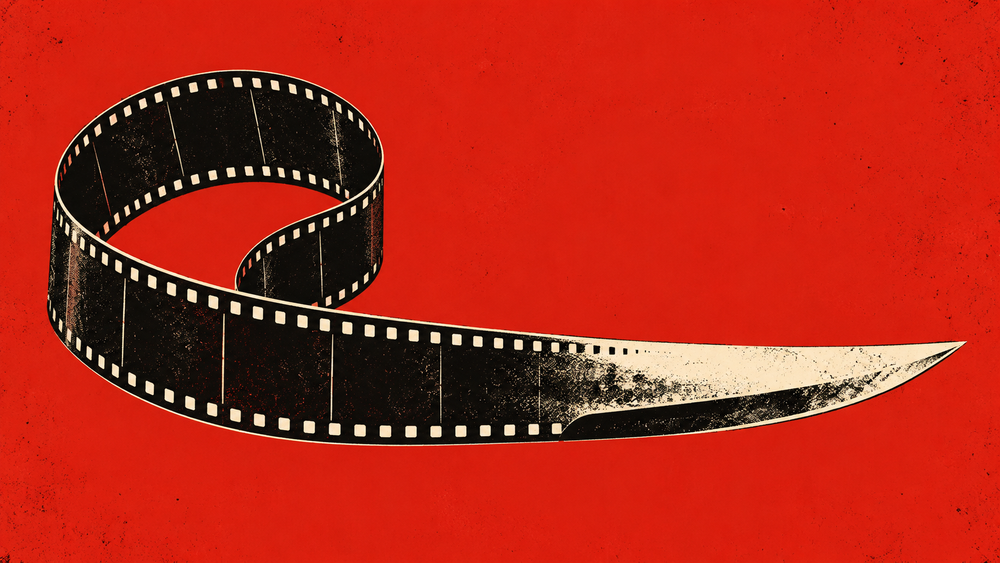
Foam axes and retractable knives crowd the prop table, and the machete lies with them. It's rubber over a spring-steel spine, and it comes from Western Costume. It has been in forty-three pictures. Two of them were pornos, and one was a Bounty commercial where it lay on a cutting board next to a cantaloupe and cut nothing.
You hold the boom pole, and the aluminum hums. The hum sits low, at the bottom edge of what you can hear, and it runs down the shaft into the heels of your hands and up into your wrists. The hum was on this stage before you were. You've told no one about it. The pole tells you all day long, mmmmmmmmmm. A man who hears what nobody else hears eats lunch alone for the rest of the shoot.
Today the hum sits higher than yesterday. Yesterday it sat higher than the day before.
Carter Saint James calls places. He was born Carl Jameson in Bakersfield. The second AC found his real driver's license face-up in the Xerox room on day three and broadcast it at lunch. Carter tells people he grew up in Connecticut. He sculpts his black hair with wet-look gel that catches the key light like motor oil on asphalt. His first picture played the market at Cannes, in a basement room where distributors buy movies for countries with more generals than theaters, and he has worn Vuarnets indoors ever since.
He has shot this scene twelve times today. They'll print take three or four, and the rest is for the orthodontists. Blood Drive belongs to three orthodontists from Encino whose contract pays out by the shooting day, and Carter learned years ago that a shooting day counts whether or not anybody takes the cap off the lens.
"Glory, baby, listen to me." Carter's hands conduct an orchestra nobody else can see. "I need terror. What you're giving me is confusion. Fear lives here, and here." He touches his own shoulders and then his own throat. "You're giving me dinner theater in Reseda."
The girl who dies lights a fresh Virginia Slim off the coal of the old one. The trick takes practice, and she has had practice. She drops the old cigarette and grinds it out, scritch, under a pink Reebok Freestyle. The Freestyle was built for aerobics, and she wears it for dying. Her name is Glory Daye, a name she took off the radio last year, and the grips hum the Springsteen song whenever she walks past. Her bleached hair is teased and lacquered into a shape the Aqua Net people could put in a brochure. Her acrylic nails meet her real nails in a visible seam, and the glue has gone yellow where it peels.
"Where's my mark?"
"Your mark is the blood pool. Hit the big one."
She looks at the syrup, and then at her white Kmart dress. It cost $11.99, and the budget bought three on the theory that she would die three times. She looks back at Carter. "There's six blood pools, Carter."
"Go to the big one."
"They're all big. You gave me that note on day three. You said, 'More blood, more blood.' I'm quoting you."
Carter pulls off his sunglasses. On this set, that means he's about to fire somebody or cry. "Use the one by the practical door."
"Which one is the practical door?"
"Jesus Christ, Glory, work with me."
"Don't Christ me. I've died in four of these pools already."
She is twenty-seven playing seventeen, and the act holds as long as you skip her hands. Her knuckles are dry. The veins stand up like blue wire in skin that spent too many summers on Zuma Beach without sunscreen.
The crew watches the way drivers watch a fender-bender on the 101. Carter puts the Vuarnets back on.
Hector Lozano adjusts his mask in the corner. It's a Michael Myers knockoff from a Halloween store on Hollywood Boulevard. The store is wedged between a wig shop and a place that moves stolen car stereos. One eyehole sits higher than the other, and the crooked hole gives his killer a look of permanent mild confusion. Hector is big enough that wardrobe bought his coveralls at a uniform store for tow-truck drivers, and all of him is going soft in the places where muscle quits. On his chair, a Polaroid sticks out of a Sports Illustrated. It shows a girl in a party hat blowing out candles, and her eyes are on whoever holds the camera.
"Are we going again or what?" Sweat runs out from the latex and drips off his chin. The other stages on the lot run air conditioning. Stage 4 has a box fan from Sears that moves the heat from one side of the room to the other, and the M&Ms in the craft service bowl have melted into one brown brick.
You hold the boom steady. Your arms are up and your elbows are locked, and your shoulders burn from eleven days of aluminum over your head. The Sennheiser 416 points at Glory's sternum. The camera motor whines at sync speed, and the whine climbs the pole and joins the hum in your palms.
Iris Graff, the script supervisor, stopped taking continuity notes on day eight. She sits on an apple box by craft service and draws in a spiral notebook. She draws houses with too many windows and staircases that turn in on themselves. She draws faces in profile, and each face goes wrong in a way that takes a second look to catch. The mouth sits too high, or the eyes aim at different walls.
Glory parks her Virginia Slim on the edge of an empty apple box and walks to her start mark. Ray the gaffer doubles as first AD, since the real first AD quit on day two, and he keys his walkie. "We're rolling."
The clock over the stage door reads 11:40. Its second hand has been jumping forward and slipping back all morning. The 5K on the key light goes back to the rental house at noon, because the production couldn't carry it for a full day and Carter got the half-day rate by lying about a second picture. The second AC holds up the slate for take thirteen and claps it.
Glory runs. The syrup grabs her left Reebok and lets it go, shhk, grabs her right and lets it go, shhk, and grabs the left again.
A bare thigh makes that sound coming off a vinyl car seat in August. The syrup soaks through the dress over her left shoulder and down her ribs, and the cotton goes see-through wherever it's wet. Hector comes after her with the machete, and the blade catches the key light you're about to lose.
The Sennheiser picks up her breath coming in short hitches, Hector's work boots on the concrete, and the rubber wheels of the dolly grinding through dried Karo. Your forearms shake. You have done this from call to wrap for eleven days. Your arms quit complaining days ago, and now they do what they're told because nobody has told them to stop.
The monitor flickers.
You catch it first. A boom man keeps one eye on the monitor so his mic stays out of the top of the frame. The flicker lasts one blink, and the picture turns to snow and comes back.
"Keep rolling." Carter's face stays in the monitor.
The picture clears. Glory runs, and Hector chases.
The snow comes back and holds while Glory runs the whole length of the hallway flat. Shapes swim up in the grain like a Polaroid coming up out of the brown. The monitor hisses, and low voices tangle into the hiss until the words and the noise run together. The Panasonic has no antenna. It takes one cable from the video tap on the camera and nothing else.
"Cut it. What the hell is that?"
Carter slaps the Panasonic and leaves a sweat print on the housing. The screen keeps hissing. You grew up with that sound. You fell asleep to it in your mother's apartment in Koreatown after Channel 13 signed off with the national anthem and left the long white nothing on the screen.
The hum from the floor climbs along with the voices, and it grows louder in the pole and in your palms.
Ray holds up his light meter, reads it, shakes it, and reads it again. "It says it's dark." He looks up at the lights. The 5K burns, and so do the 2K, the pair of 1Ks, and the baby juniors along the back wall. The needle on his meter lies flat against its pin.
Glory picks her parked Virginia Slim off the apple box and strikes a match, fsst, and lights up. "You hear that?"