Cold Call
The dead man arrives with half a face. The right side stayed at the grain bin off State Road 12, where the auger took Harlan Dietz at the collar and the deputies walked the dry October beans until dark for what the machine let go. They came back with a cap and a hearing aid. The left side still belongs to Harlan Dietz, sixty-one on the intake sheet, grain farmer. The right side now belongs to Ansel Marsh.
Ansel washes the body with germicidal soap. He shaves the cheek that exists. He sets the features before the chemistry, the way his father taught him in this same room, under this same tube light with its green stutter. An eye cap goes under the surviving lid. The needle injector goes against the gum.
Tak. The barb seats in the mandible. Tak. The maxilla takes its twin. He twists the wires together and the mouth agrees to stay shut.
He raises the carotid with an aneurysm hook and ties off high. Twenty-index fluid, cut with warm water, runs the line. The Porti-Boy pushes, color climbs the neck the way dawn climbs a silo, and he keeps his eyes on the pressure gauge until the gauge is all there is. Later the trocar drinks the cavities dry and the hydroaspirator argues in the sink until he shuts the valve.
Then the wax comes out. The face divides into thirds, hairline to brow, brow to the wing of the nose, nose to chin. The ear runs the length of the nose. The mouth runs the width of the pupils. His father kept the rules taped inside the supply cabinet, and the tape yellowed, and the rules held. Ansel derives the ruined side from the whole one, wire and cotton first, then wax carved thin and stippled to take a pore. The ear he builds runs the regulation length, and the lobe he hangs on it swings free of the jawline, a soft unattached lobe that Harlan Dietz never grew.
At four the van from Hollander Floral backs up to the dock. The reverse alarm quits, the door slides, and Iris Hollander comes out of the diesel smell with a casket piece riding her forearms like a sleeping child.
"Two standing sprays and the spray for the lid," she says. "The stargazers rode up front with me. Your cooler runs colder than mine, so they go in first."
"The service is at ten."
"Then they peak at ten." She rests the piece on the rail while he signs. Green stains ride the heel of her hand. The smell of cut stems comes off her wrists, the green blood of things cut this morning and still taking fluid. "Anthers are pulled. Pollen outlasts bleach, you know that better than anybody."
Her invoice slants uphill, every seven crossed. The left corner of her mouth tucks when she takes the clipboard back, a small fold, a stitch of skin that catches and releases. The thirds of her face run long in the middle. Her mouth runs wider than the width of her pupils, and the rule loses, and Ansel signs the clipboard.
She hands the lilies across. "Careful, they bruise."
The dock ritual runs four o'clock to four oh two, Thursdays, and it has run six years. The freight changes with the calendar. Peonies come up the ramp in May with the ants still working them. Gladiolus comes all summer. December brings evergreen blankets wired for the graves, her breath showing over the boxes, the clipboard crossing in gloves. He orders through the funeral home account. He has never stood inside her shop. She has never stood inside his prep room. Between them they dress every funeral in the county, her side of the casket and his, and the clipboard passes back and forth across the dock like a border checkpoint that stamps nothing.
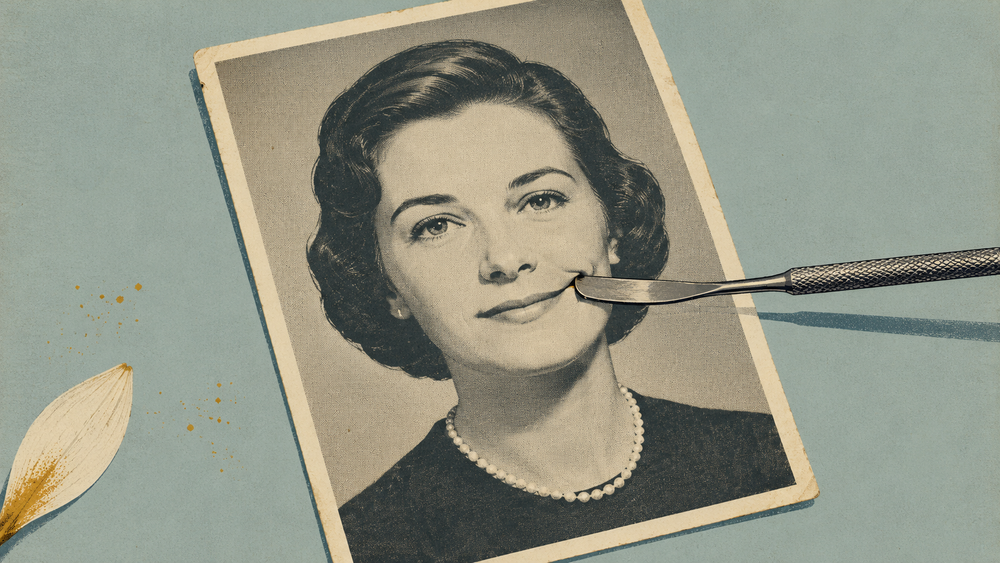
The habit started with Ruth Ambler, four years back. A clot went into the right hemisphere and shut down the left side of her face, and after that she chewed on the right and kept a napkin pressed to the left corner for whatever got away from her, and death came through behind it and notarized the damage. Ansel wired the mandible, set the line of closure, and the mouth came out level and wrong, a mail slot cut into a kind face. He stood over her with the spatula until the wax went cold enough to work twice. Then his thumb tucked the left corner into one small fold, a stitch of skin that catches.
Gerald Ambler leaned into the casket the next evening and stayed bent a long time. "That's her about to laugh," he said. "Fifty-one years, she always looked about to laugh. Where did you find that?" Ansel straightened the register book and gave the answer the trade gives, which is nothing.
The trade calls the last look the memory picture. The casket opens, the line files past, and whatever face waits on the pillow overwrites every face that came before it, the wedding face, the hospital face, the face across forty years of breakfasts. His father sold it in the arrangement office in exactly those words, and he kept a second line for the families still deciding: the face you bury is the face you keep. A lid stays open for three thousand dollars more of casket. A good memory picture outlasts the house.
Word traveled the way word travels among people who plan funerals, which is quietly and all at once. Marsh & Son got a name for the mouth. Families who would have closed the lid started paying to leave it open. Then the name grew past the mouth.
The drowned teacher, Carol Fenwick, took the unattached lobe, and her sister touched her own ear at the rail without knowing her hand had moved. Deacon Pardoe took the brow, one arc set a hair higher than its partner, the asking arc, and half his congregation wept at a question he had never worn in life. Dana Till from the drive-through window took the philtrum, that shallow channel above the lip, and her mother said she looked ready to say oh. Bev Lockhart, who cut hair in her kitchen for thirty years, took the eyelid crease, and her daughters called it peaceful, and peaceful is the word families reach for when the face is doing a thing they can't name.
Ansel attends the visitations he builds. He stands at the back by the door where the draft comes in, in the same gray the folding chairs wear, and he watches families arrive at his work. A farm wife bends to Bev Lockhart's eyelid and speaks another woman's name at it. A grandson studies Deacon Pardoe's brow and promises it he'll do better. Three counties carry her in their memory pictures now, a lobe here, a fold there, distributed the way a careful man distributes anything he can't keep in one place. They kiss the mouth he gave Ruth Ambler and they think they are kissing their mothers. Nobody in those rooms knows whose face they are saying goodbye to. Most nights Ansel counts himself in that number.
On the bad nights he drives past Hollander Floral after close. The cooler glows blue through the front glass. Buckets stand in rows inside the glow, roses, carnations, her namesake irises that die faster than anything else she sells. He idles at the stop sign the law requires and goes home to the apartment above the caskets.
In June the van backs in with a boy driving, earbuds in, a laminated route sheet on the dash. He stacks the delivery on the dock edge, and a box of lilies slides off and lands flat, and he says the box is fine, and he leaves. By evening brown thumbprints rise on the white petals where the cardboard pressed. They bruise.
"Iris on vacation?" Ansel asks him the next Thursday.
"Who?" The boy checks the route sheet. "I got hired through the wholesale house. They cover deliveries when an account goes quiet."
Three Thursdays run empty. Ansel orders sprays for the Hutchins service and a voice at the shop takes the order down wrong. He corrects the spelling of gladiolus and hangs up and stands with his hand on the phone in the arrangement office, among the sample urns, until the hold music he is no longer hearing stops in his ear.
The county morgue calls on a Sunday about a release, one removal, the usual run. The clerk reads the sheet in the clerk's voice.
"Hollander. First name Iris. Thirty-four. Single vehicle, rollover, State Road 12. Family's asked for Marsh."
The road runs between her shop and the wholesale house in Terre Haute. The flower market opens at four in the morning and the vans come back loaded at dawn, and hers came back on its roof in the beans a half mile past the Dietz bin, and the deputies who walked those rows in October walked them again in June, picking stargazer lilies off the blacktop and standing them upright in the ditch grass, a job no report carries a line for.
Ansel does the removal himself. He drives the van slow on 12 both directions.
In the prep room he unzips the pouch to the waist and stops and stands with his hands at his sides. The compressor kicks on behind the wall, hnnnn, and runs, and he puts his hands to work because his hands are the only part of him with a license.
He washes her with germicidal soap. Trauma took the left side of the face, orbit to jaw. The right side survived whole, and the weather line survives on it, that border where the dry lip meets the wet, and her lashes survive, and the green is gone from her hands. He sets the features first. An eye cap goes under the right lid. The injector goes against the gum.
Tak.
His thumb rides the wire an extra beat before the twist.
Twenty-index fluid runs the line, color climbs, and the gauge holds steadier than the hand that set it. The trocar stays in its drawer longer than it should and then does its work. He packs and sutures and builds the left orbit out of wire and cotton, and he lays the foundation wax, and then he arrives at the mouth, and the mouth is the whole examination, and he has been first in this subject since Ruth Ambler.
The rule says derive the ruined side from the whole one. He reads the right corner the way he has read six years of Thursdays.
The right corner holds level. No fold rises. No stitch of skin waits to catch. He tilts the lamp and reads it again, and the anatomy declines to testify. A mouth at rest carries no weather, his father used to say. The dead hold structure, and structure is all the wax can take. The tuck he has installed on four years of strangers lived in her left corner, if it lived anywhere, and the left corner is with the lilies in the ditch grass, and what he holds in evidence is the copy of a copy of two minutes a week in loading-dock light.
He goes to the file cabinet the way the manual orders, reference before reconstruction. Every restoration sits in its folder in Polaroid, before and after: the Ambler file, the Fenwick file, the Pardoe file. His own work looks back at him from every sleeve. He owns no photograph of Iris Hollander. He owns editions.
He opens the wax tin.
His thumb makes the fold before he votes on it.
He carves the rest of the night. The lamp burns a white ring on the steel. When he finishes, the face on the table matches the face at the back of every visitation he has ever haunted, and it lies there with its small fold catching nothing, about to laugh for nobody, and Ansel washes his hands past clean at the sink.
Lorraine Hollander comes for the identification viewing on Wednesday. She stands no taller than the casket rail in a wool coat too warm for June, and she refuses the chair twice. Ansel folds back the cover cloth to the shoulders and steps to the wall.
She stands at the table a long time. Outside a mower goes over the cemetery and turns and goes back over. Her brow sits heavy and level under the collar line. Her mouth runs wide past the width of her pupils. His eye takes her thirds without permission, the way his eye takes everything, and he stands against the wall with his hands folded like a man at his own visitation.
"You do good work," she says. "Everybody in this county says you do good work." The mower turns. "Who is that?"
"We can adjust anything before tomorrow."
"Your father buried my mother. He had a line he liked. The face you bury is the face you keep." She keeps her eyes on the table. "Ruth Ambler had that same little thing at the mouth. I stood at that casket and told Gerald she looked about to laugh. Carol Fenwick had my daughter's ears. I stand in all the lines, Mr. Marsh. It's a small county."
The cover cloth stays folded exactly where he folded it.
"I told myself you had a style," she says. "Painters have a style. I told myself that at three funerals."
Her purse clasp gives its small click. She takes out a photograph in a plastic sleeve, the sleeve gone soft and cloudy from handling, and she holds it out without looking at it, the way people hand over the last of the money.
"Her cousin's wedding," she says. "Her father took it the year before he passed. Use this one. She never made that face in her life."
The woman in the photograph laughs with her head thrown back. Her mouth runs wide, wider than any rule, and the front tooth carries a chip from a diving board or from anything, from a life. The brow sits heavy and level with no asking arc anywhere on it. The nose bumps at the bridge where a nose gets broken young and set at home. She grips a bouquet of stargazers with the anthers left on, and the pollen has already found the front of her dress, rust-orange, ruinous, and she is laughing too hard to care.
A stranger looks out of the plastic sleeve.
Six years of Thursdays ran four o'clock to four oh two. He holds the photograph flat on both palms, the way she handed the lilies across. They bruise.
"Tomorrow at ten," Lorraine says, and buttons the coat, and goes out through the smell of other people's flowers.
The prep room at midnight holds one white ring of lamp on steel. The photograph leans against the wax tin.
He works. He widens the line of closure past the width of the pupils, out to the width the laughing woman demands, and the rule loses, and he lets it lose. He mixes a heavier brow and buries the arc. He loads a No. 2 brush and paints the chip onto the tooth, a flake of absence, the cheapest repair he has ever made and the only one that ever subtracted. He builds the bump into the bridge with wax the size of a lentil. He checks the photograph between every pass. The stranger in the sleeve laughs at the ceiling and gives him nothing to keep.
The corner waits.
He sets the spatula flat and takes the fold out in one pass. The wax comes away in a curl the size of a lash. He smooths the corner level, level as the right side, level as a mouth at rest, and he lifts the spatula, and his thumb comes down on the warm wax behind it and lays the fold back in.
He takes it out. His thumb lays it back.
He takes it out.