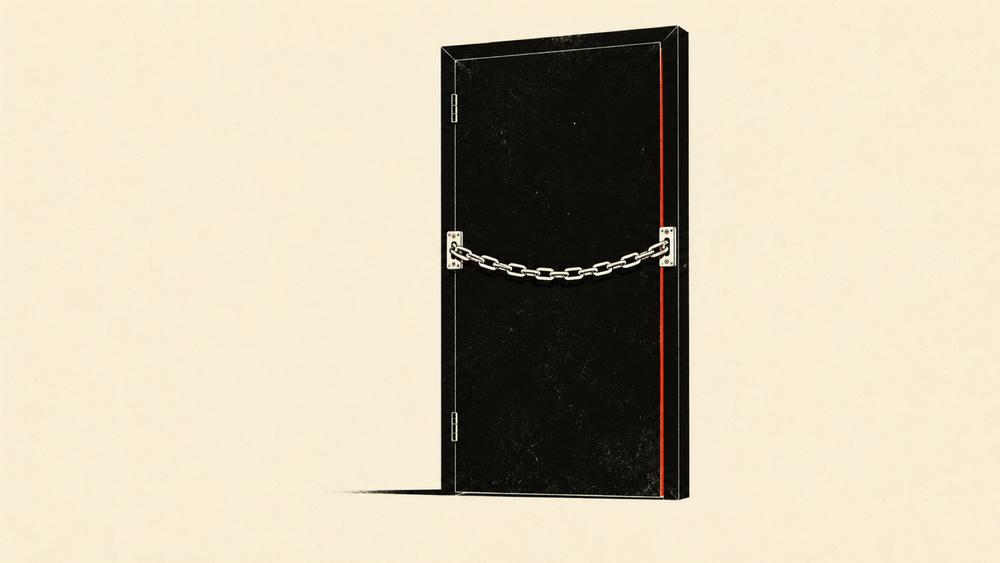
Close the Door
Noah held the peach can up to the radio's green dial and turned it to check the seam for rust. It would keep. He set it back with the others. The Del Monte cans stood on the counter in rows with their labels facing out. His mother lined her shelves the same way in Albuquerque. She said you should always be able to read what you had left. The rows had been longer when he bolted the chain to the door frame.
The Ingersoll on his wrist read 11:58. His father, David, had worked that crown with his thumb whenever a calculation at Los Alamos went bad, and one side of it had gone smooth. The second hand drifted backward for a few ticks, stopped, and went on the right way.
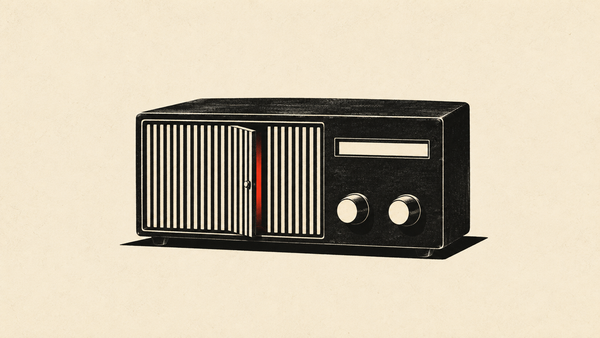
The radio was a Zenith Trans-Oceanic out of a supply crate that came down under a parachute back when the planes still flew. A crowd closed under the crate before it touched the ground. Noah got the radio because he was faster than everyone around it, and because he didn't stop for the penicillin. On a clear night it used to pull in Lisbon. The Zenith was a receiver, and every part of it was made to listen. Every night, he switched it on and gave the dead world a mouth.
The dial threw pale green light across the table and the notebook and the Model 31 Remington pump leaning against the wall at his elbow. A frayed loop of butcher's twine hung from its trigger guard, and Noah had never cut it. The magazine held buckshot. He had loaded one shell of birdshot first so it would come up last, and it was left over from a box his father bought in 1938. Birdshot would do nothing to anything that mattered now. He kept it loaded anyway.
His father taught him to shoot with shells from that box in a field outside Albuquerque while the Sandias went purple, and David put his hand over Noah's hand on the pump and said, "Here, like this, keep your elbow tucked," and the gun went WHAM and shoved them both back a step, and David worked the pump under Noah's hand, and the spent shell, red paper and brass, flipped out of the port and caught the last of the sun and turned over and over in it before it landed in the dust.
The notebook lay beside the radio, open where its spine had broken. In the earlier pages his father's small, cramped physicist's hand filled every line. Toward the end the letters loosened and leaned, and the grooves under them deepened. The last entry was dated November 8th, 1945. The pencil had gone through the page.
CLOSE THE DOOR.
David Caswell died before December. The cough started up on the Hill at Los Alamos and came home with him when the war ended. It stayed dry through September, went wet when the cottonwoods along the river turned yellow, and then it brought up what the doctors called tissue because they needed a word for it. Noah held the basin at the end. What came up last moved on its own. Small shapes folded and unfolded on the white enamel. His father's chest settled and stayed down. Noah waited for it to rise. He kept waiting until the window went from afternoon to evening.
Noah shut the notebook and wiped his hands on his pants, though they were dry. The apartment smelled the way it always smelled, of rust and dust and the flat, alkaline warmth of a room that had been breathing him back.
11:59.
Every night since he bolted the chain to the frame, the broadcast had come at midnight on 1210 kilocycles. It was a woman's voice, and it was a recording. It said the same words in the same order with the same pause before the last line, and Noah always let out one breath in that pause. He had never had to hurry it.
A man who'd gone down to the coordinates and come back said he'd seen her through the blast glass. She sat pale and upright, and her lips moved a half-beat behind the words.
The second hand swept through twelve.
Click.
"This is The Last Station. Coordinates: forty degrees, forty-two minutes north—"
She read the numbers the way a nurse reads a man his own blood pressure. Noah settled into the chair. Green light on his knuckles. The Remington at his elbow. The Del Monte in its rows.
"—seventy-four degrees, zero minutes west. Survivors, tune in."
Noah let his breath out into the pause. He still had air in him when she came back.
"We are not alone."
He turned his right ear to the grille. The left had been no good since Buffalo, where the thing wearing Captain Morrison's face broadcast from the armory on Connecticut Street until everybody within earshot of it went deaf on one side. A medic on the road east had looked in the bad ear and called him lucky.
His thumbnail nudged the dial into the gap between 1210 and 1220. His father called that gap the ghost frequency. The main signal thinned out there, and whatever else was on the air came through.
"—repeat: do not respond. Survivors, remain hidden. The enemy is—"
The voice was hers, and the words were new. Then the air went dead. Noah held his breath until he had to let it go. The second hand ticked backward and caught.
Pop.
"Is anyone there?"
The man's voice had a smoker's rasp and no spit in it. Noah's hand went flat on the table.
"Please." The voice dropped. "If you're out there. If anyone—"
The man stopped, swallowed, and started again.
"I'm at... Christ. I don't know. Somewhere near Cleveland, I think. The highway signs are melted. There's a water tower. It's making a sound. A singing sound. I've been walking for... I don't know."
Noah's map lay folded under the notebook. He had come east on Route 66 and then Route 20, and on his way through Cleveland he had put a red X over it in grease pencil. Nobody near Cleveland was walking anywhere.
"Hello? Can you hear me?"
The rasp did it. For a moment Noah sat at the kitchen table in Albuquerque again with the oilcloth under his elbows. Across from him his father read the Journal aloud in the voice Los Alamos had left him, and a cup of Sanka went cold at his elbow.
"Dad?"
The word got out before he could close his teeth on it.
The frequency went silent. Noah worked the smooth side of the watch crown with his thumb.
"Who is this?"
Noah looked at the Zenith. He had spoken into a box that couldn’t send a signal, and someone had heard him.
"It's Noah." His own name came out in two pieces.
In October he had stood in the hall outside his father's bedroom and watched through the gap in the door while David held a Geiger counter to the plaster wall and the clicking climbed until it ran together into one long tone.
"Dad, it's me."
"Noah."
The static around the name pulled apart, and the frequency came in cleaner than anything he'd caught since the chain went on the door.
"Oh God. Son, I thought you were—"
White noise slammed out of the speaker, KSSSSHHHHHHH, and drove Noah back from the grille with his good ear ringing. The overhead bulb went dark. While it was out, the green dial laid the Remington's shadow across the floor in a long diagonal that touched the door. Then the bulb came back.
"Dad?" His hand was on the tuning knob, and the Bakelite was warm. "Dad, where are you?"
"—repeat: do not respond."
The woman from the Station came in over the static the way oil spreads over water.
"Any survivors who receive this message: do not respond. The enemy is listening."
"Dad?"
"They become what you need to hear."
Green light on his hands. The notebook on the table, shut now, its pages swollen with pencil. The second hand going around.
"Noah, don't listen to her. I'm here. I swear to God I'm here. I found a way through. I've been trying to reach you for—"
"You died." Noah had said it before, in other rooms, to faces that wouldn't believe him. "You died in Albuquerque. November twenty-seventh. It got dark while I waited for your next breath.”
"I know." His father had saved that tone for skinned knees. "I know what you saw. But I'm here. The dark has another side, Noah. I crossed it. I came back."
Noah's hand closed on the Remington's stock. The walnut was warm from the room.
"You need to leave the city. Right now. Tonight. They're using the Station's signal to triangulate survivors. They have your frequency, Noah. They've had it since you turned on the radio."
"Who?"
The overhead bulb went out with a thin tink, and the room dropped into green. Noah felt across the table for the Army flashlight, thumbed it on, and stood it with its angled head toward the door. The red filter was still in the lens. The apartment filled with the color of a darkroom. His father had worked under that light in the windowless rooms at Los Alamos.
"The ones who answer back." The words crowded each other now. "They learned to sound like us. They're in the building. In the wiring. In the—"
The transmission cut.
Red light. Green light. The tubes glowed orange through the vents at the back of the case.
Then the woman came back, so close to her microphone he could hear her lips part.
"Do not respond." She set the same space between every word. The static around her voice braided itself into breathing, and the breathing came from many lungs filling at once in a large room.
"They learn, Noah."
Noah pushed his chair back until it hit the wall. He kept the Remington against his leg and his thumb on the watch crown. Every night since the chain, the broadcast had run the same.
The recording had just said his name.
"Apartment 4B." Her voice had gone easy, as though she'd pulled up a chair. "Your father was David. Los Alamos, Omega Site. He wrote it down, didn't he? In the notebook on the table."
Noah lifted the Remington and set the stock against his shoulder and his cheek against the walnut. The trigger guard was cold under his finger in a room that had been warm when the broadcast started.
"We've always known where you are." She said it like a grocery list. "We were waiting for you to speak."
The carrier dropped out.
Noah brought the gun down across his knees and swept the band with his free hand. The dial turned under fingers that had the shake all the Caswell men got in their hands. His grandfather had it on the buttons of his overcoat. His father had it on the Geiger counter. 1200, static. 1210, static. 1220.
A voice came through, and the noise nearly pulled it apart.
"Noah."
David had used that voice at the kitchen table whenever he wanted his son to believe everything was fine.
"I'm sorry, son. I tried to warn them."
Noah leaned in and put his good ear to the grille. His mouth tasted of rust.
"Don't answer the door."
The noise closed over it. When his father's voice came back, the static had gone out of it, and whoever was talking had leaned close to the microphone.
"I'm coming up the stairs now."
Click.
The tubes hummed in the case. Out in the stairwell a tread took weight, and then the one above it. Whatever climbed moved at a sick man's pace. One floor down it stopped to cough. His father had brought up the same wet cough in October.
Noah stood and carried the Remington to the middle of the room and faced the door. A Schlage deadbolt. A Master padlock threaded through a chain he had bolted to the frame himself. An ASSA cylinder left by a tenant whose name he never learned. Towels plugged the gap at the bottom. He had taped their edges down with olive-drab Army tape, and the tape had curled at the corners.
The flashlight behind him put a red oval on the steel. The weight on the stairs reached the landing outside and went quiet.
Through the corner where the tape had lifted, cold came into the room the way water comes into a boat. It found his ankles first. It kept coming.
One knuckle tapped the steel. It was the knock of a man who already knew what was inside and knocked anyway, so the thing inside could believe it had a choice.
Noah pushed the safety off. His breath hung red in front of him.
Knock, knock-knock, knock, knock.
The knock was shave-and-a-haircut. After it came the quiet where two bits belonged.
When Noah was seven and the dark made sounds he couldn't explain, his father knocked that on his bedroom door and waited until Noah knocked two bits back on the headboard. Then David came in and sat on the edge of the bed with a hand on Noah's shoulder and said, "It's just the pipes, buddy, just the old pipes," and he stayed until Noah's breathing evened out.
The quiet went on. Noah kept his knuckles wrapped around the stock.
"Son?"
His father's voice came through the steel and the chain and the towels and the tape with the gravel still in it. It said son the way David always said it, like a man handing over a glass he was afraid to drop.
"Noah, are you there?"
The barrel had crept up. Noah brought it down to the center of the door and braced the stock against his hip. On the steel the red oval dimmed and came back.
"Let me in. I know you're scared. I know what she told you. But I'm here. I can prove it."
Between sentences it breathed through the steel. The air took on the copper bite of a cut wire.
"Ask me anything."
Noah kept his mouth shut. The voice gave him a moment, then went on without him.
"Remember the Sandias? The evening we shot the Remington? You flinched on every pull and I said that was smart. I said flinching meant your body understood what it was holding."
David had said exactly that, in November of 1938, while the spent shell turned over in the last of the sun.
"Remember the Sanka? I never finished a cup in my life. Your mother found them everywhere. On the piano, on the bathroom sink, on top of the Geiger counter once." The pause after it was the length of a breath taken for effect. "She said I treated coffee like a New Year's resolution."
Noah's mother had gone east to her sister's in Silver Spring after the funeral. Her letters stopped in September. The hands that wrote them might not be her own anymore.
"Things only I would know, Noah. Things from before."
The doorknob turned until the Schlage stopped it. The door shifted against the bolt, and the chain swung, and the padlock knocked once against the frame. Then the knob turned home.
"Please." The voice sank to the pitch people use in hospital rooms, in kitchens before the milk truck comes, and at the end of a life. "I've been walking for so long. I just want to see my son."
Noah was crying. He kept the barrel on the center of the door.
"Let me in, Noah. Before they find us both."
Noah took one step toward the door. The board under his left foot creaked. He had stepped around that board every night since the chain. The sound went out through the floor and into the steel, and in the hallway the breathing stopped.
Then it started again, slower and more even than any lungs he'd ever heard.
"You got it back." The voice had a smile in it now. "The Remington. Eleven dollars on Central Avenue, and you kept the twine. That's my boy."
Noah went still.
His father sold the Remington in October of 1945, a month before he died. Noah found the empty shape of it pressed into the felt of the gun cabinet. David said it was only a tool and he needed the codeine more. Three days after the funeral, the gun turned up in a pawnshop window on Central Avenue with the ticket tied to the trigger guard with butcher's twine. Noah paid eleven dollars for it. He threw the ticket away and kept the twine.
Noah raised the Remington to his shoulder. His fingers shook, and the barrel held. Red light on the steel. Green light on his knuckles.
On the table, a draft from the window lifted the notebook's cover, and the pages fell open where the spine had broken, at the last words his father wrote.
CLOSE THE DOOR.
The breathing in the hall stopped again.
Through the steel and the chain and the locks and the towels and the tape came the small, damp sound of a palm laid flat against the other side of the door.
"I can wait."
The red oval on the door dimmed and came back. On Noah's wrist the second hand swept forward, then back, then forward. On the counter behind him the Del Monte cans stood in their rows with their labels facing out, so you could always read what you had left.
"I can wait a long time."
The palm started down the steel, shhhhhff, toward the corner where the tape had lifted.
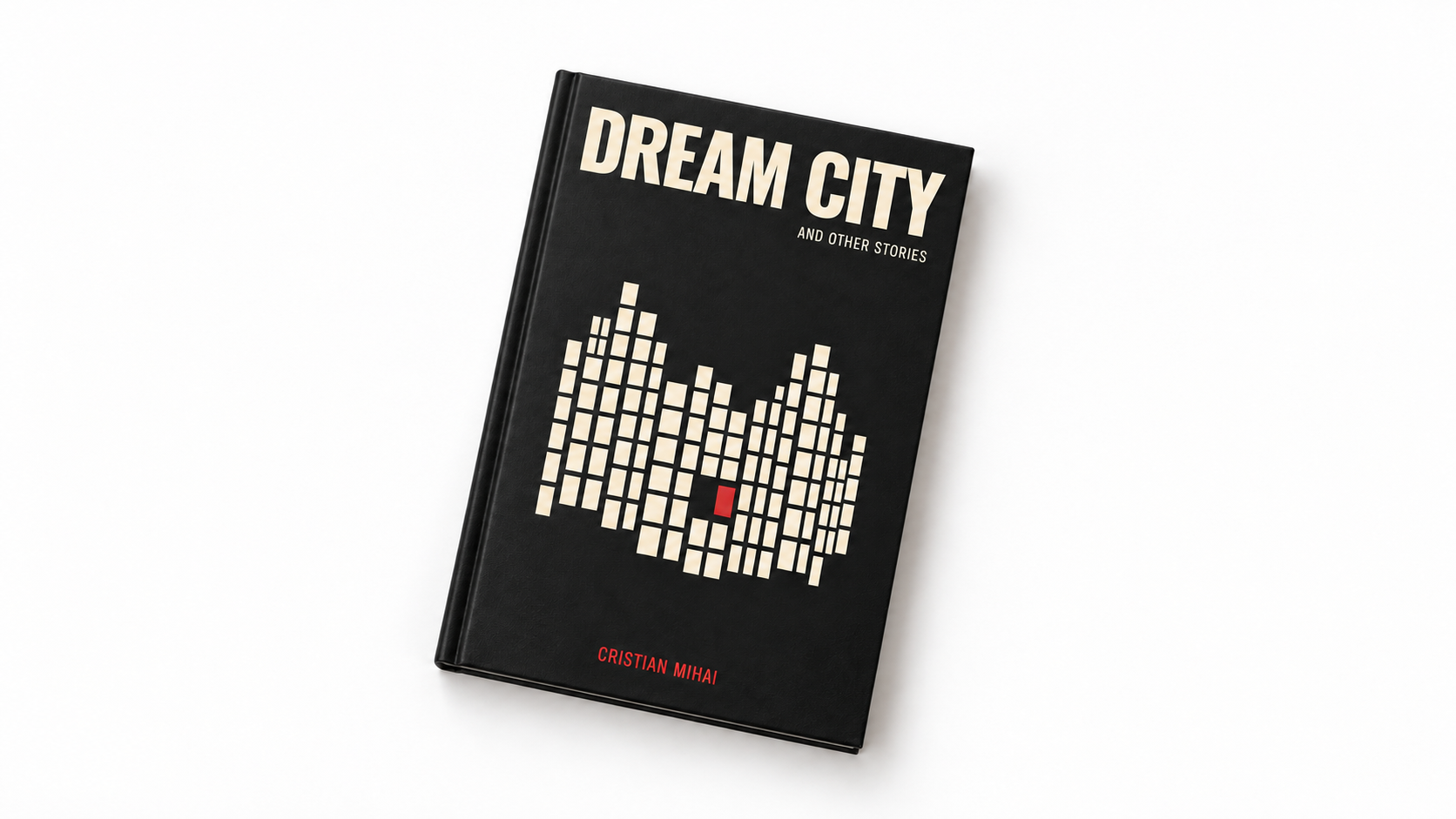
This story is one of forty-two in Dream City and Other Stories, a book about people in the minute before something terrible or absurd happens. The stories move through literary horror, dark comedy, and satire, and they stay funny at the worst possible moment. The fifth edition is on my e-store and on Amazon.