Keys
The bathroom mirror holds Thomas's face the way a jar holds a specimen. The bulbs over the glass are the clear round kind Una picked for putting on makeup, and they find every burst capillary and every pore gone wide. Colgate Total has crusted in the corner of his mouth. He has the face of a man who sleeps in installments.
He runs the faucet and holds his hand under it until the cold gives up. He knows how long the cold lasts. He splashes his face and scrubs at the crust, and the towel smells of the Gain Una used to buy. He still buys it. It sits at eye level in Aisle 7 of the Giant on Route 29, and every week his hand has the green jug in the cart before he has read a label. At the register he types in her phone number for the discount.
Leaving the apartment takes three objects. Wallet, phone, keys.
The wallet is in yesterday's jeans, over the bedroom chair where Una's robe used to hang. The chair still faces the window she liked for the tree line late in the afternoon. He never turned it back toward the room. He takes the wallet and leaves the jeans.
In the kitchen the stove clock says 7:03. Out the door at 7:05 puts him through the badge reader at Morrow & Associates before 8:00. He is ahead.
The phone lights the black granite blue. He thumbs past two emails from a mattress company, one asking whether he is still thinking it over and one announcing that it has saved his cart, and past a notice that fourteen people have endorsed him on LinkedIn for Project Management. He has never spoken to any of them. At the bottom of the stack sits a calendar reminder he set three weeks ago. Buy milk. The milk is on the back wall of the Giant where Aisle 7 ends, and he turns his cart in front of it every week, and the reminder pings every morning, and the refrigerator shelf stays bare.
He pockets the phone. He reaches for the keys and his hand closes on granite.
His fingers have already made the shape of them: the Honda key with its fat black head, the apartment key, the mailbox key, the ring. He took them out of the bowl by the front door and set them here, next to the phone, on the stove side, before he went in to brush his teeth. The clock said 6:59. They landed with a small bright clink. His hand did it and his ears heard it.
Objects stay where you put them. It is the one promise they make.
The counter holds last night's glass with a skin of bourbon dried brown in the bottom. He lifts the glass and looks under it.
7:06.
He pats his back pocket, his front pocket, his other front pocket. Wallet, phone, his own thigh.
First you look where a thing could be.
The jacket hangs on its hook by the front door. Both front pockets, the inside pocket. Lint, and a receipt from the Mobil on Rockville Pike, dated December, $38.12 in regular unleaded. He puts the receipt back.
Under the hook sits the white bowl with the blue stripe around its rim. The keys spend the night in it. Una's mother put it in Una's hands at the wedding and closed her own hands over them. Inside: pennies, and a ticket stub from the AFI Silver that says February and ADMIT ONE and has gone soft along its fold. He sat in the fourth row and stayed through the credits and read the names.
7:09.
No keys, no Honda. No Honda, no cubicle at Morrow & Associates, no ergonomic chair with the broken lumbar support. Proctor keeps a tardiness spreadsheet on a shared drive that everyone pretends they can't open and everyone has bookmarked. Thomas has two yellow cells beside his name. The third cell turns red. Red is a meeting with HR and a cardboard box, and then Una's lawyer calls, and the flat voice reads him the support figure from page nine and asks how he would like to proceed.
He works his fingers down between the couch cushions and comes up with a AA battery, a pen cap, an almond gone soft. He lifts the cushions out. On the bare frame: dust, a hair tie, a receipt from Szechuan Palace dated July 19. Kung Pao chicken, extra spicy. Ma po tofu. Two Tsingtaos. On the tip line, in his handwriting, 22%.
"Why not twenty?" Una said. She had the receipt turned around on the coffee table. "Why not twenty-five?"
"Twenty-two is accurate."
She looked at him, and then at the receipt, and then she found the remote. They ate the rest with the television on.
He puts the cushions back and lines up the seams.
Then you look where it could never be. The keys have never once been in the cabinet over the stove. He opens it. Two mugs. One is plain white. The other is oversized and the orange of a traffic cone, and its handle snapped off once and went back on with epoxy that has since gone yellow. Una brought it home from a gas station four Christmases ago. She held it up in the kitchen doorway with both hands and laughed the laugh that started in her nose and broke open. His thumb follows the glue line. He closes the cabinet.
Behind the toilet tank: dust, and the husk of a silverfish.
He backs out of the bathroom on his knees and sits down in the hallway with his spine against the wall. The carpet is thin enough that his tailbone finds the slab. It smells like Aisle 7 at the Giant. Una sprayed Resolve foam into it at the end of every month. He sprays it at the end of every month.
After she left, everything on the refrigerator calendar in her red pen had already happened. November 3, dinner at Marcel's. October 14, matinee, AFI Silver. September 22, a red circle and no words. He took the calendar down the week before Christmas and put it out with the recycling, and he bought the kind with landscapes at CVS. January is Yosemite, Half Dome at sunrise. The refrigerator still says January.
Clink.
Keys on stone, in the kitchen.
He lifts his head. At the far end of the hallway the keys lie on the granite beside the bourbon glass, on the stove side, where his hand went the first time.
He stays on the floor and looks at them. His breathing is the loudest thing in the apartment. A pipe in the wall ticks once and stops.
He gets up. He walks the hallway. His hand stops above the keys, and then he picks them up, and they are as cold as metal left overnight in a car in January. The cuts of the Honda key print themselves in his palm.
7:12.
Wallet, phone, keys. He walks past the jacket on its hook and takes the stairs.
He shoulders the building door open. The air tastes of diesel and wet asphalt, and the sky is the flat gray of a window nobody has cleaned.
The lot has sixty spaces, stenciled B-1 through B-60 in yellow paint the weather has mostly taken. He has never seen it full.
Every space holds a car.
Every car is a silver Honda Civic.
Thomas stops on the walk. His hand goes into his pocket and closes around the keys.
The Civics sit nose to the curb and tail to the aisle, and each one is his. A 2017 LX sedan. Clear coat gone chalky across the hood. A shallow dent in the rear quarter panel on the driver's side. The dent is from the Giant, fourteen months back. He was loading the trunk when a loose cart came down the slope of the lot and found the Honda with the sound of a knuckle on a classroom desk. He stood with a bag in each hand and looked at the dent. Then he loaded the bags and drove home.
Each bumper carries the same white-on-black sticker. I BRAKE FOR EXISTENTIAL CRISES. Una found it at a Sunoco on Route 50 the week he bought the car, on a drive with no destination. She stuck it on in the parking lot while he was inside getting coffee. When he came out she was standing behind the Honda with her arms crossed and her chin up, a woman waiting for applause. He handed her a coffee and pressed down a corner she had missed.
Each plate says Maryland, 4BF 2196.
He checks the phone. 7:13. He walks the aisle, and his footsteps come back off the trunk lids a half-beat late, and the cold comes through his shirt. The lot should end at B-60, at the chain-link and the dumpsters. Where the chain-link was, there is more lot. B-61. B-88. B-140. The stencils run on in the same worn yellow toward the tree line, and every space holds a silver Civic with a chalky hood and a dent.
His breath leaves him in white threads that hang a beat too long.
He goes back to the nearest car, B-12, which sits two steps off the walk. The key slides into the driver's door with the drag he knows and catches at the half turn, where it has caught since the first winter. Click. The door opens. The cabin smells of drive-through coffee and of three years of napkins packed into the console. The seat foam is dented in the shape of him, and the dent runs deeper on the left, where he leans in stopped traffic.
He shuts the door.
B-9. The same drag, the same catch, the same dent in the seat. The E-ZPass hangs crooked on the windshield from its one good mounting strip. On the passenger mat lies a receipt from the Union Station garage, two weeks old, from the afternoon he drove downtown to sign the papers. Una sat across the conference table in a blue blouse he had never seen and earrings he had never seen. She signed, clicked the pen twice, and set it down.
A third car. A fourth, across the aisle. Every lock turns. Every seat has his shape in it.
The phone buzzes against his leg and he takes it out. 7:15, and under the time, two notices. The calendar: Buy milk. A text from a contact he has saved as the letter U.
The preview begins Are you, and he presses the side button before the third word. The glass goes black and holds his face.
B-7 is the number on his lease, his mailbox, and his front door. He walks to it. The key turns. He gets in, and the seat takes his weight.
The wheel is cold at ten and two. His father put his hands there thirty years ago in a Safeway lot in Bowie while a Buick LeSabre idled under the two of them.
"Ten and two," his father said. "That's where your hands live."
They have lived there since.
The rearview mirror holds his face. The gray light through the windshield is kinder than the bathroom bulbs. He could pass for a man who sleeps.
He turns the key. The starter grinds, the four-cylinder catches with its asthmatic rattle, and the dash lights up: 41,006 miles, 7:17.
Every engine in the lot catches with it.
One note, held, row after row, out past where the chain-link used to be. From every tailpipe, the same white breath.
In B-6 and in B-8 the engines run, and nobody sits in the dent in either driver's seat.
He puts his foot on the brake and in the mirror the row across the aisle goes red, tail after tail, and he pulls the shifter down to R and between every pair of red lights a pair of white ones comes on, and the phone goes bzzt against his thigh, once, and whatever comes after Are you stays in his pocket, and he lets up on the brake.
The Honda rolls back. Across the aisle the Civic in his mirror rolls back to meet it, and its sticker reads right to left.
SESIRC LAITNETSIXE ROF EKARB I
His hands stay at ten and two. The letters get bigger.
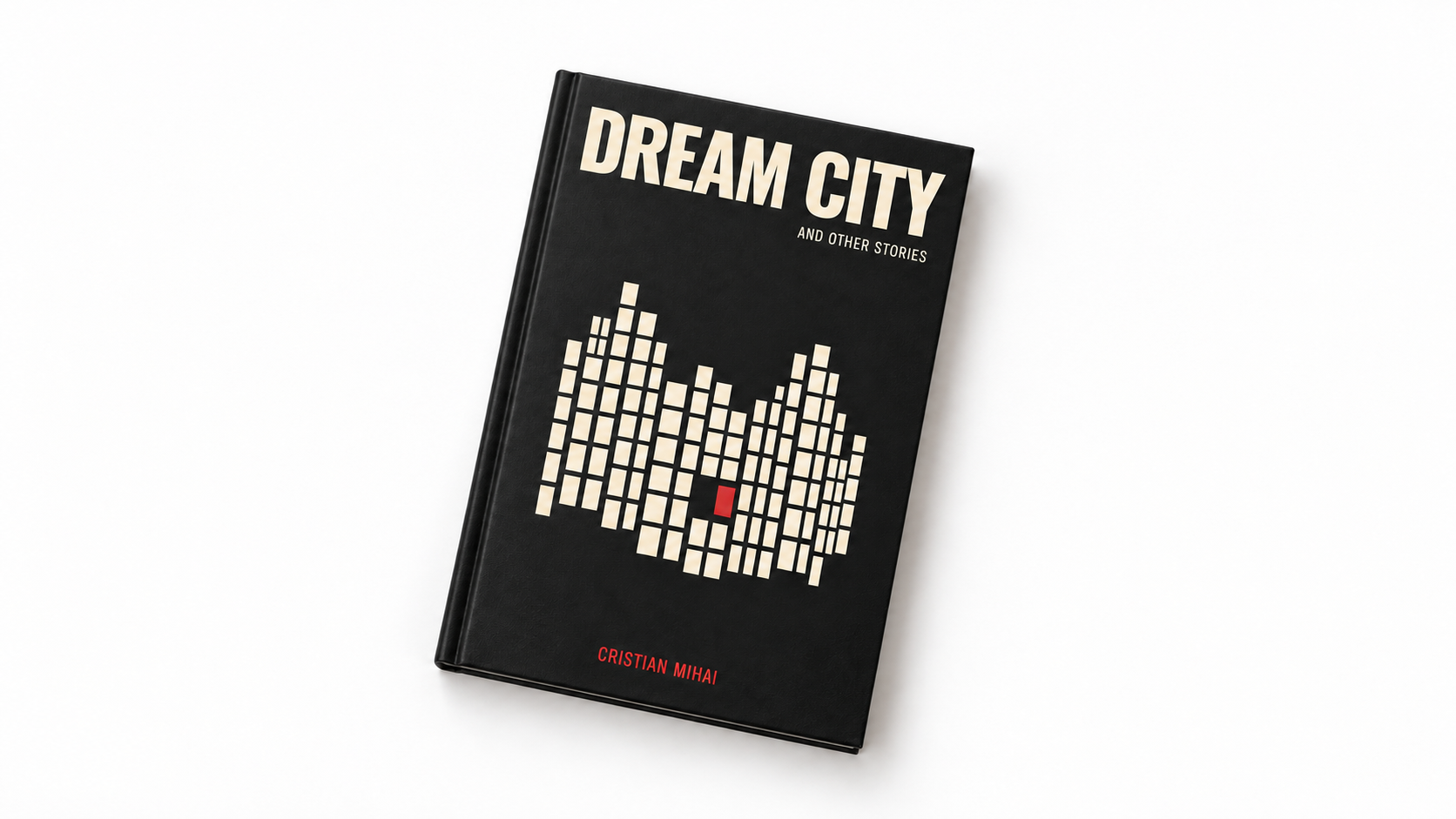
You’ve read one. Forty-one more wait in Dream City and Other Stories, on my e-store and on Amazon.