Rated X for Projection
The tube over Hays's chair gave off the light they hang over a deli case, and every face in the room came out the color of sliced turkey. Our metal chairs stood in their semicircle facing the screen. Each chair had a college-ruled pad on the folding table in front of it. Somebody had left a bran muffin on the table. It sat there all evening like a seventh committee member and contributed about as much as Comstock.
Whitehouse uncapped her Montblanc the way other people cross themselves at a church door. She set the cap beside her pad with the clip pointed at the screen. Bowdler built the same grid she built every week. She squared her notepad to the table's edge, laid her pen across it at a right angle, and set her folded reading glasses on its upper right corner. Hays had loosened his tie and rolled his sleeves to the elbow; he had the forearms of a man who used to build things and now sat on committees about things other people built. Comstock wore his headphones around his neck with the cord wrapped in his fist. He had already written the date at the top of a fresh page and underlined it. Breen kept his head down and filled a page with shorthand nobody else could read, and nothing had happened yet.
We decided what the county was allowed to see. Every week a film came down to the basement clean and went back up with a letter on it.
I opened the committee laptop. It was a beige Dell from 2011 with a spacebar that stuck. Its screen threw blue light across the muffin's crumbled edge and down to the scratches in the linoleum, where our chairs had carved the same arcs week after week. I kept the log. In eleven years the log had never disagreed with anybody. The projector bulb had been cooking dust since morning, and the room tasted like it.
The man from AV plugged the projector into the Dell, pressed play, and never once looked at us. He hit the switch on his way out.
Chk.
The tube died. The projector put a white square on the screen, and the top of Comstock's head stood in the bottom of it until he slid lower in his chair.
The film opened on soft cumulus over a meadow. Dentists put that sky on their ceiling tiles to keep you calm while a stranger roots around in your mouth. The timecode on the Dell ran past two minutes before anybody wrote a word. By our standards, that was generosity.
Then Whitehouse leaned forward, and the Montblanc trembled over her pad. "Stop."
I hit pause.
"That one." She aimed the Montblanc at the screen like a dowsing rod. "Second from the left. Do you see the shape?"
Every neck in the room swung around like barn owls finding a mouse in the grass.
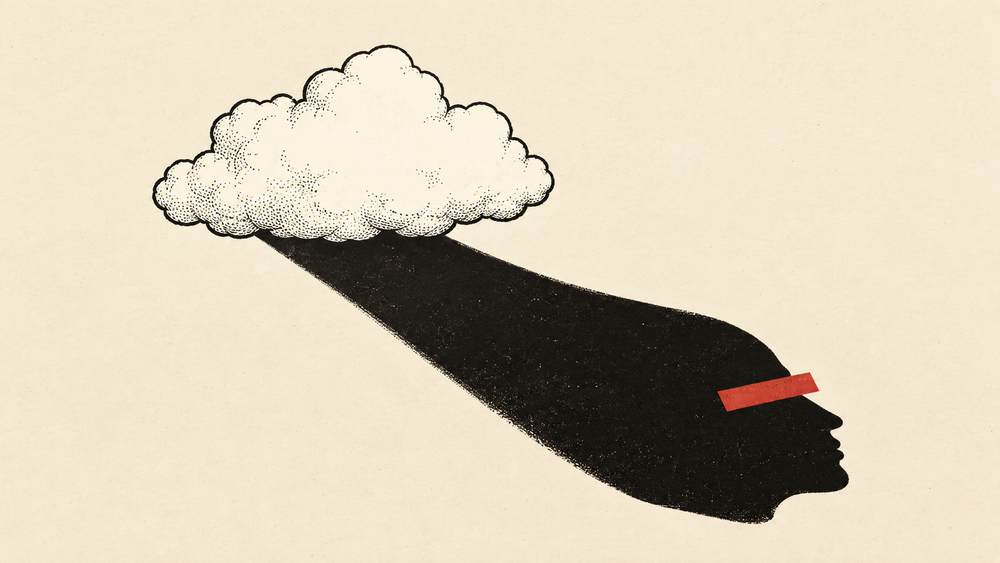
The cloud hung long and bulbous, and the low sun had turned its edges copper. It was the kind of shape you find in the grain of a bathroom door you've stared at too long in a house gone quiet.
I laughed. Nobody joined me, and the cinder block sent the laugh back to me alone.
Hays pressed his pen into his pad until the page dimpled. "This can't be accidental. It's a metaphor. For carnal unity."
He used the voice I had heard from him only once before, years back, when he walked Bowdler through how a cathedral arch holds up its own stone.
Comstock wrote:
cloud = sex???
He looked at it a long while. Then he scratched out the extra question marks and let one stand. Comstock treated punctuation as a moral stance.
I pressed play. The cloud dissolved into a cobblestone street. A man walked a terrier past half-timbered houses, and the man and the dog dragged long shadows over the stones. Whitehouse had already filled half a page. Hays worked his knot down to the second button of his shirt. Bowdler underlined one word so hard the paper tore.
At 22:40 on the timecode, the film brought out doughnuts.
They cooled on a wire rack beside a window with gingham curtains. Some were powdered and some were filled with cream. The camera lingered on them the way cameras linger on faces in perfume ads. Children ran into the frame laughing and grabbed at the rack with small sticky hands, and powdered sugar came away on their fingers.
Bowdler sat forward so fast her chair went SKREEEK across the linoleum, and the cinder block threw the noise back flat. "The boy's tongue. Watch the boy's tongue on the glaze."
I ran it back. A boy of seven or eight licked a doughnut and came away with a sugar mustache. He grinned and bit down, and a ribbon of cream curled out of the middle.
"Sick," Comstock said. He wrote the word on his pad and circled it.
The circle lay on Comstock's page the way the muffin lay on the table. All of us could see it, and none of us touched it. Then every one of us wrote down the boy's tongue, and our pens moved in the dark like insects walking on glass.
The children's laughs came through the speakers loose and straight from the belly; they hadn't learned yet where they weren't welcome. Bowdler's pen cut short hard strokes into a notepad that had swung crooked to the table's edge. Her glasses had wandered off their corner. In eleven years I had never seen her grid break.
I wrote:
22:40. Children / doughnuts / cream. Requires further review.
Hays's pen hovered over his page and stayed there. Whitehouse capped the Montblanc and laid it flat on the table like a soldier grounding his rifle.
I pressed play.
At 51:18 a grandmother filled the screen. She sat knitting in a wingback chair beside a fire. Burgundy yarn. Aluminum needles that caught the firelight every time they came up out of the wool.
Tik. Tik. Tik.
Breen hadn't said a word all night. He had filled page after page with his shorthand. Now he lifted one finger and traced the path of the needles in the air. "The rhythm. Phallic. The insertion angle."
"Vaginal," Hays said. "The receiving loop."
"Both," Bowdler said.
The grandmother's hands kept their pace. She wore a cardigan buttoned to the throat and had her feet up on the ottoman in wool socks. The shot held on her face long past the point where any editor would cut, and her lips moved around words nobody had bothered to mic. Whitehouse uncapped the Montblanc again.
Comstock fit his headphones over his ears, pulled them off, and fit them on again. The cord swung and tapped the table. "Those are eights. Aluminum eights."
Nobody asked how he knew. Comstock wound the cord back around his fist. "She reminds me of my mother."
He hung the headphones around his neck and closed his eyes. Then he leaned toward the speaker in the corner with his lips apart, and his whole upper body tipped out over the table the way a child tips toward a nightlight.
I hit mute. Up on the screen the needles kept going without a sound. Comstock kept leaning toward the dead speaker. Then he opened his eyes, looked at my finger on the trackpad, and sat back.
The others went back to writing, and their pens made the sound of mice in the walls. My pen lay beside the laptop. My fingers were laced in my lap.
The film ran mute through coastline and wildflowers and a horse alone in a field. None of it earned a line in the log. At 1:04 the man with the terrier walked to the edge of a cliff. Waves smashed on the rocks under him, and the mute button swallowed them. A gull came across the frame on the wind off the cliff, and the same wind laid the grass flat.
Breen dropped his pen. It rolled under his chair, and he let it go. "The gull's shadow."
The gull crossed the sun, and its shadow ran over the grass at the man's feet and stretched and shrank across the uneven ground and was gone before the terrier lifted his head.
"A womb," Breen said.
"A mouth," Whitehouse said.
"An arch with no keystone," Hays said.
The pens took that down too.
Bowdler's pen had stopped. She stared at the screen with a face I had seen on her once before. Years ago she came down to a screening, laid out her grid, and folded her hands on the table, and a pale band of skin ran around her ring finger. She said nothing then. She said nothing now. Her thumb went to that finger and rubbed at the skin.
I saw a bird.
I picked up my pen. Set it down. Picked it up. The gull came back into frame with its wings tilted on the updraft, and it was still a bird. It had white feathers and hollow bones and one idea in its head, and the idea was fish. It tipped a wing and slid down the cliff toward the water.
Across the table, Hays had stopped writing. He was looking at my page, where nothing had gone down since the doughnuts.
I wrote:
1:04. Gull / cliff / shadow. Phallic silhouette in flight path, vaginal rock formations below waterline.
Hays went back to his own page.
My handwriting matched everyone else's. The projector blew its heat across my face, and the walls held the stale air like cupped hands around a dead match.
The credits rolled at 1:22. The last card thanked the terrier by name.
Hays stood first and crossed to the switch. The tube took its time coming back, and when it did, we were all sliced turkey again. He pulled his tie up to his collar and cinched the knot. "They knew what they were doing."
Bowdler and Breen nodded, and Whitehouse wrote it down.
I typed the report. The spacebar stuck, and after every word I brought my thumb down on it and it clacked like a gavel.
RATED X FOR PROJECTION. The director must address these transgressions. Subliminal content pervades every frame. The committee recommends restricted classification pending full review.
I printed it. The inkjet groaned and pushed out one warm page, and my thumb smeared the wet ink at the margin. Hays signed it with his eyes on the line for his name.
Comstock had already gone. Bowdler reached the door next. Her glasses were folded in their case, and her notepad was squared away inside her bag. "Same time next week?"
"Same time next week," I said.
She left. Breen followed her out, and his pen stayed under his chair. Whitehouse capped the Montblanc and slid it into her breast pocket on the left side. She kept her hand flat over it all the way to the door.
Hays waited until the hall had emptied. He stood with one hand on the switch and looked at the blank screen. Then he worked his knot loose again. "Do you think anyone actually watches these? After we rate them?"
Dust still drifted where the projector's beam had been. It came down on the folding table and the muffin and the empty chairs.
I didn't answer.
He hit the switch, chk, and the tube died.
We walked out through the lot and past Comstock, who sat in his Corolla with the engine off and the window cracked. He had his headphones on and his eyes closed, and his lips were moving.
Hays's taillights left the lot. The security lamp bolted to the corner of the building washed my car and the Corolla yellow. I got in and fit the key in the ignition and left it there. Moths beat against the lamp, and their shadows crossed my windshield and opened and shut and opened.