Specimens
The first time Olivia noticed the boy next door, he was performing surgery on the dead.
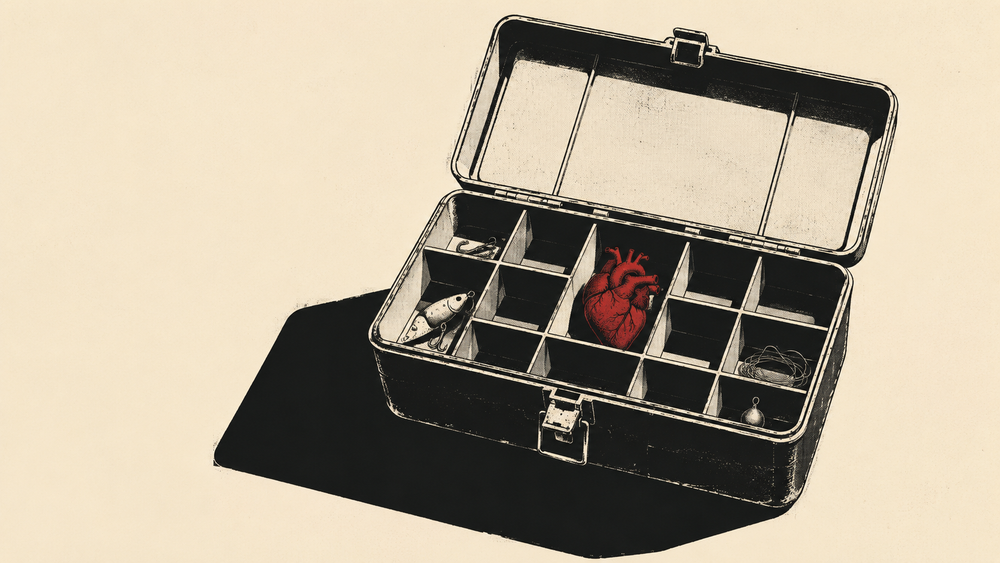
It was a Wednesday, after the late news. The sodium-vapor streetlamps, the orange ones the city council bought in bulk in 1987, buzzed over the street and turned every lawn jaundiced and every face into a missing persons flier. A freshly killed squirrel lay on the curb. The boy sat cross-legged beside it in yellow latex gloves, the kind from under kitchen sinks, with a Walmart tackle box open on the asphalt. He worked with an X-Acto knife, a pair of tweezers, and a mechanical pencil from AP Biology that he used as a probe with the lead retracted.
He peeled the fur back with the patience of someone unwrapping a gift they already knew would break. The ribs underneath stood like tiny prison bars, the intestines lay coiled tight as earbuds crammed into a pocket, and the lung tissue had deflated to a wafer.
Olivia sat on her porch with one Nike Air Force 1 dangling off the step and a Diet Coke sweating on the pressure-treated lumber. She'd come outside to smoke the Marlboro Light she'd stolen from her mother's emergency pack, the one hidden behind the expired flour where nobody in the house looked because nobody in the house baked. The cigarette sat unlit between her fingers.
"Hey."
It came out of her the way a knee jumps under a doctor's hammer.
He looked up through fogged glasses. A smear across his left cheek could have been blood or could have been Hershey's syrup. The sodium light refused to settle the question.
"Uh. Hey."
He still gripped what looked like a femur between latex-covered thumb and forefinger. His sleeves had bunched at the elbows over thin, pale forearms, and the veins showed dark in the orange light. Neat parallel lines ran down the left forearm from the middle toward the wrist.
"You're gross, you know that?"
He shrugged and returned to work.
"Why do you do that?"
"I wanted to see how it worked." He lifted a dark, wet organ into the orange light and turned it the way a jeweler turns a stone he suspects is fake. "The blood vessels branch out. All these tiny highways. And they all connect."
The cigarette had gone damp with sweat. She pocketed it without lighting it.
He sorted the squirrel's organs into the tackle box's compartments, the ones built for fishing lures. Each chamber now held a piece of what had kept a small animal running that morning. He hummed a tuneless line while he worked. It was the sound of someone who had forgotten anyone could hear him.
She stayed until he snapped the latches on the tackle box, clack, clack, and peeled off the gloves and walked back to his house without saying goodnight, without looking up.
Inside, she washed her hands. Her father snored in the recliner downstairs, a sound like a bandsaw hitting a knot, and its motor hummed along with him. He'd slept there every night since the bypass, because lying flat meant drowning, and the hum of that motor had become the sound of her father staying alive.
She brushed her teeth, spit the toothpaste into the sink, and went to bed.
The recliner hummed through the floor.
His name was Wesley Rourke. The cafeteria called him Milquetoast. Sophomore year, two boys had pinned him to the linoleum and poured whole milk over his head while three hundred phones recorded it, and someone set the footage to circus music, and by homeroom the name replaced his.
Olivia had watched the video on Ashley Frazier's bed during a sleepover, and Ashley had laughed so hard she'd snorted Sprite through her nose, and Olivia had laughed too.
The next Wednesday she tore a page from chapter twelve of her physics textbook, the one on Thermodynamics and Irreversible Processes, and wrote across it in black Pilot G2:
You wanna do something gross tonight?
She slid it through the vent slots of locker 318, then posted up near the water fountain between classes and watched. He found the note, read it twice, then folded it and pocketed it.
After dinner the October air stung the sinuses, and the moon hung dissolved and pale like a tablet dropping through water.
She waited in her backyard under the dead oak her father had promised to take down the spring before his chest opened.
Wesley came through the gap between the privacy fences. His Jansport hung heavy, and the weight inside lolled when he walked.
"I brought something."
Wesley ran the zipper back, tzzzz, and the bag opened on matted fur.
"Jesus Christ. Is that a cat?"
"Found it on Route 12. Shoulder of the road."
He tipped the bag, and a female orange tabby with clouded eyes slid out onto the dirt. Rigor had set the jaw in a slight grin, as though the cat found its own death funny. The smell came with it: blood gone to rust and the thick sweetness that gathers where fur meets wound. It was the smell of a body keeping no more secrets.
"Gross."
Wesley grinned. She'd never seen his teeth. He looked younger with them showing.
"You wanted gross."
They knelt in cold dirt near the dead oak, and the ground resisted their knees. He had brought his Swiss Army knife, and she had brought her mother's German-steel Henckels kitchen shears from the 1998 wedding registry, the year her parents still believed in things that required registering.
On the first cut he wrapped his fingers around her wrist and adjusted the angle. The latex was cold and slightly tacky against her skin.
"Lighter. Let the blade work."
The fur parted under the shears and showed a liver the color of a bruise going green at the edges. Kidneys nested like quotation marks around the spine. The small intestine was compressed into the volume of a child's fist. Cold air made everything steam.
He snapped out the small blade of his Swiss Army knife, snick, and pointed with its tip. "Spleen. Filters blood. Recycles dead red blood cells. Your body runs a whole recycling program and never tells you."
"Like a background app."
"Exactly like a background app." He went back to work.
He named things while she held the flashlight. The beam caught structures inside an animal that weighed less than a newborn: a trachea no wider than a drinking straw, an aorta the width of a pencil, a diaphragm thin as cling wrap. Her fingers went numb and she kept holding.
"Can I ask you something?" he said.
"You just did."
"Why are you here?"
She looked at the open cat. Everything inside it sat where it belonged.
"I don't know. Same reason you are, maybe."
He reached into the cavity and lifted the heart free. It was dark red and small enough to lose between couch cushions.
"You want to hold it?"
She held out her hand, and he set the cold heart in it. It weighed no more than an AA battery, and her whole arm held it.
"Can I keep it?"
He looked at her. Behind the fogged glasses, his eyes were the color of creek water after rain.
"It's yours."
She dropped the heart into a mason jar from the recycling bin, thup, and ordered formaldehyde on Amazon Prime. The jar sat on her desk between the framed cheer squad photo from regionals and a half-burned Yankee Candle in Midsummer's Night.
Her mother picked up the jar and held it to the light.
"What is this?"
"Art project."
Her mother set the jar down and centered it on the desk the way she centered throw pillows and dinner plates and every object in her life that could be made symmetrical. Her nails were fresh French tips from her standing appointment at the salon on Maple Street, the one that served champagne in plastic flutes.
"Don't leave it where guests can see it."
The door closed, and the house settled into its programmed evening. Downstairs the recliner buzzed where her father slept upright in a robe that never stayed closed over the pink scar on his chest.
Olivia held the jar to her desk lamp. The lamp turned the formaldehyde amber, and the heart cast a shadow on the wall the size of a thumbprint.
She texted Wesley a photo without a caption.
Three dots appeared, disappeared, and came back.
nice
A second text came in before she could answer.
same time next week?