The Marcher
The man marching on Glÿkon's left has stopped sweating.
A body in this desert sweats until the water runs out. Then the skin goes dry, and the color goes to liver, and the man walks one more day, two if the nights come kind, and then he sits down. Every ranker in the column has watched the whole course run. The dry skin is the sign.
The man on his left is a Thessalian. Glÿkon learned his name three rivers ago and lost it two deserts back. The Thessalian's lips have split white at the centers. His eyes point at the ground and take nothing in.
Glÿkon holds a mouthful of water against the roof of his mouth. He has held it since the cold hour before dawn, swallowing it back a sip at a time, the way his father taught him to carry a dry week on a mouthful. The goatskin at his hip slaps his thigh with each step, too empty to hold still.
Up ahead, a helmet travels hand to hand toward the front of the column.
One of the Agrianians found a seep in the rocks and scooped the bowl of his helmet through it and ran it forward before the heat could take it back. Glÿkon cannot see the king from here. He finds the king by the men, by the small straightening that passes down the column the way wind passes through standing barley.
The helmet tips.
The water goes into the sand. The sand drinks it and does not even darken for long. Then a sound moves through the army that Glÿkon will carry into his own dying, ten thousand throats too dry to cheer, cheering anyway, and the sound comes out raw, comes out red, comes out of a place in the chest that will never fill again.
He works the stopper loose with his thumb.
Pok.
He sets the skin in the Thessalian's hand and folds the white fingers down over it.
"Drink," he says.
The Thessalian drinks. His throat moves. He hands the skin back lighter, and Glÿkon stoppers it and hangs it at his hip and faces east, where a king has poured a ransom of water into the dirt and made it taste, in every cracked mouth that watched it fall, like the only water in the world.
His father grows barley on a slope above Mieza where the soil runs thin and the stones come up every spring like a crop of their own. A boy learns that land through his back. By the time he can carry, he carries. By the time he can bend, he bends, and the bend stays in him, a sapling tied to a post that grows toward the post forever.
His father reads water the way priests read entrails. He reads where it runs under the ground and where it surfaces. He reads the green tongue of grass on a brown hill that marks a spring no eye can see. He reads the soil's color for what it has drunk and when, a handful held to the nose, a clod crushed in the fist. The whole religion passes from the old man's hands into the boy's hands without one word a temple would own as prayer.
The recruiters come up from Pella in the second year of the reign. The barley has failed. Glÿkon goes because third sons go. His mother folds bread into a cloth and saves her weeping for after he turns the bend in the road, and his father walks him to the bottom of the slope and stands there with his hands hanging.
"Come back," his father says.
Then the old man climbs back up to his stones, and Glÿkon goes down to the road, and the road runs to Asia, and Asia has no bottom.
The phalanx is a body, and a man inside it is one cell of the body.
They teach him this first, and he learns it last. The file runs sixteen ranks deep. The pike of the man four rows back rides Glÿkon's shoulder, and that pike and the ones behind it slant down past his ear toward the place where the killing happens, so the front of the column grows a hide of iron that no horse will run onto and no man will walk into who wants to keep his face.
At the Granicus the river runs red below the ford, and the dead turn in the current and snag on the rocks, and the rocks hold them half out of the water, and the column steps through the shallows and does not speak of it.
At Issus the dust climbs until the sun goes the color of a bad yolk, and no man can find the standard, and Glÿkon holds the line by the smell of the man beside him, fear-sweat and onion and hair oil gone sour, and he stays alive by staying inside that smell.
At Gaugamela the line bends and bends and refuses to break. Off on the right a gap opens in the Persian world, and the king goes into it like water into cracked stone, and the whole Persian world splits along the crack, and Glÿkon sees none of it. He stands on the left, where Parmenion drowns in his own wing. He holds. He fends a Persian off with the splintered butt of his pike, and the man beside him opens the Persian's belly, and neither of them says a word, and the dust eats the sun, and the body that is the army swallows the field whole.
A ranker does not love war. A ranker loves the king who squats in the same dust and tears the same bread and chews it where the men can see him chew.
The Thessalian dies two nights after the helmet.
The cold takes him. The desert turns on a man after dark, and it freezes him inside the same skin the sun flayed at noon. The Thessalian gave his cloak to a man whose own cloak went for bandages. By morning he lies under a frost so thin the first light burns it off, and his eyes stand open and hold sand.
No one digs. No arm carries the strength, and the ground would spit him back. Glÿkon lifts the water skin off the dead hip, his own gift come home, and he takes the bronze disc the Thessalian wore on a thong, a stamped horse on it, the kind a mother buys at a roadside shrine and presses into a son's palm so the road will hand him back. He hangs it around his own neck.
He marches. The body that is the army runs smaller now, feeding itself to the sand a man at a time, into rivers, into cities whose names never reached the rear ranks. It leaves them where they drop because stopping is joining them. The file that stood sixteen deep stands four deep, five, whatever still breathes. A gap opens where a man ate beside him. A gap opens where a name almost landed. The army wears its dead the way a sick man wears his clothes, the same shape, the same stitching, the fabric hanging looser every week.
He meets the king once in eleven years, up close, on a bad night.
It happens years back, in another country with another desert in it, in the long chase after a king who was already a corpse and had not been told. The wells come up dry or come up plugged with the bodies of the men who dug them. The column moves at night to stay out of the sun, and a night march in that country is a blind crawl across a furnace gone to embers.
Glÿkon falls out of the line.
His knees quit taking his weight. No decision passes through him and no surrender passes through him; the body spends itself down to the husk, and the husk sits in the dark while the dark slides past, shff, shff, shff, the column going by, clink of bronze on bronze, men too far gone to mark one more man down.
A shape comes down out of the dark and crouches in front of him, and the smell of it arrives first, and the smell is nothing. That is the wonder Glÿkon will carry longest. The shape smells of sweat and dust and old blood and a body run to the end of itself, the same smell as the man who died beside him at Issus, the same smell as every ranker in the line. The king smells like the army. The king smells like a man.
A hand takes his jaw and turns his face up. The starlight comes down hard and white and warms nothing, and the face above him hangs burned and cracked, and the eyes in it work over his face.
"On your feet, soldier."
The hand pulls. Strength comes through it that no arm in that desert has any claim to, or the strength belongs to Glÿkon all along and the hand only shows him where he left it, the way a man lifts a stone in company that he could never shift alone. He comes up off the ground. He stands. The shape is already moving, already down the line to the next one, because the dark is full of men sitting down to die, and one man goes from each to each with the same four words in his mouth.
Glÿkon puts one foot in front of the other. He does not fall out again, that night or any night after. He marches two more years on the memory of that hand, across every river still ahead of him.
The river kills more than the desert, when the reckoning comes.
This comes later, on the way out of India, in the country before the long inland turn, where the riverbeds still fill in the wet season. The army camps in the dry bed of one because the bed lies flat and runs wide enough to lay down the train, the women and the children and the merchants and the sick, all the soft cargo an army drags behind it the way a comet drags its tail.
The rain falls in mountains no man in the camp can see.
It comes down the dry bed in the dark, a wall of brown water taller than a man, and it takes the tents and the carts and the sleeping and the sick, and it takes the women who walked out of Macedon along the whole spine of the world, and it takes the children born on the march who never saw Macedon and never will. Glÿkon stands on the high bank with his tent-group because their file-leader is a careful man who trusts no riverbed, dry or wet. They stand in the roar and can do nothing, less than nothing, while the water hauls its load past below them, and a voice comes up out of it once, a woman's voice, saying a name, and then the river has the name too.
By morning the bed lies scoured down to bright sand and a few poles. A doll of plaited reeds turns in a pool the flood forgot to drain, around and around, and no child stands near it, and no child stands anywhere, and the men who lost wives in the night look at the clean sand and make no sound, because the first man who opens his mouth will take the rest of them down with him.
He keeps the reed doll. He carries the horse-disc off the Thessalian and the reed doll out of the river and a flat gray stone with a white seam that he took off the slope above Mieza the morning he left, a stone his father would have read for water. The things weigh nothing and buy nothing, and he carries them the way a stabbed man carries the blade still in him, because pulling it out is where the bleeding starts.
The desert takes the animals first.
The mules go down to the belly in the soft sand and scream, and no rope brings them out, and after a while the men stop hauling and start cutting them where they stand. The meat comes off bad. No water exists to boil it clean, so they eat it raw or charred over broken wagon-wood, and the eating sickens them, and the sickness wrings more water out of a man than the meat puts in. That is the trade of this march. Every gain runs at a loss. Every meal is a small dying.
The king sees it. The king sees everything and rests his eyes on none of it. He walks the camp at dusk with his face set on the standard and the horizon and tomorrow's line of march, his face turned off the men jointing his baggage train in the firelight, because seeing it is forbidding it, and forbidding it is murdering them. So he unsees it. It is the one mercy left in his gift, the mercy of the blind eye.
He walks. That is the other thing. Litters wait empty in the train. Officers ride. The king walks, on feet cracked open like any ranker's, in the dust with the dust, and a man marching the rim of his own death watches the king go past on foot and finds one more hour in legs that hold no more hours, because the king holds none either and is spending his anyway, in the open, where a nobody can watch him pay.
A king who rides while his men walk is a king, and men fight for kings. A king who walks when the litter waits, who tips his water into the sand where the men can watch it go, who climbs down into the black to lift a nobody off the ground by the jaw, that king has done a thing to a man that will not come undone. He has made the suffering shared. He has made it mean. A man will follow shared suffering to the edge of the world and over the edge, down into the dark and the cold and the clean scouring water, because the one thing crueler than all of it is suffering it alone, and alone is the thing the body that is the army was built to end.
Glÿkon lays the march out in the cold the way his father lays out a harvest.
Eleven years have gone into it. Two thousand miles have gone into it; the surveyors pace it out on knotted cords and say so. He crossed the Hellespont a boy who could carry and bend. He crossed the Granicus and the Tigris and the Euphrates and the Oxus and the Indus and a hundred streams with no names, drinking from them on his knees like an animal. He stood in the body at the great fields and held where holding was the whole of the work. He killed men whose faces come back to him in the cold hour, the way the Thessalian's face comes back, the way the woman's voice comes up out of the river. He buried friends in cities whose names never reached him and left more unburied in sand that refused them. He has marched eleven years on a hand laid against his jaw and four words spoken in the dark.
And the king does not hold his name.
The king touched a thousand jaws in that desert, or ten thousand. The king lays the same four words on every shape that drops out of the line, the same hand, the same weight, and moves on, and could no more name the man off the slope above Mieza than name every stone in the empire he owns. The hand was for whatever sat down in the dark. The eyes that read his face like soil read ten thousand faces that same night and lost each one as it stood up. He is a cell in a body. The body holds one will, and the will belongs to another man, and the will does not carry his name in it anywhere.
He sits with that in the cold. He turns it over the way he turns the gray stone with the white seam.
It changes nothing.
He would cross all of it again, the rivers and the cold and the friends fed to the sand, for a man who could not pick him out of any ten rankers rotting into Asia, because the king bleeds where they bleed and walks where they walk and drinks what they drink, which in this desert is nothing, which is sand poured from a helmet, and a man who asks of you only what he has already asked of himself can ask for the whole of you, and you hand it over, and no one calls it a debt, because no debt runs in this direction. His father's tongue on the slope above Mieza holds no word for it. The beggar's Persian he learned to ask water in holds no word for it. The king holds every land and every word and not one ranker's name among the thousands he has poured himself out into.
Glÿkon stands up. His knees take his weight. He goes and finds the line.
This story is set in the world of King of Kings. The novel asks why men loved Alexander enough to die for him. "The Marcher" is the answer.
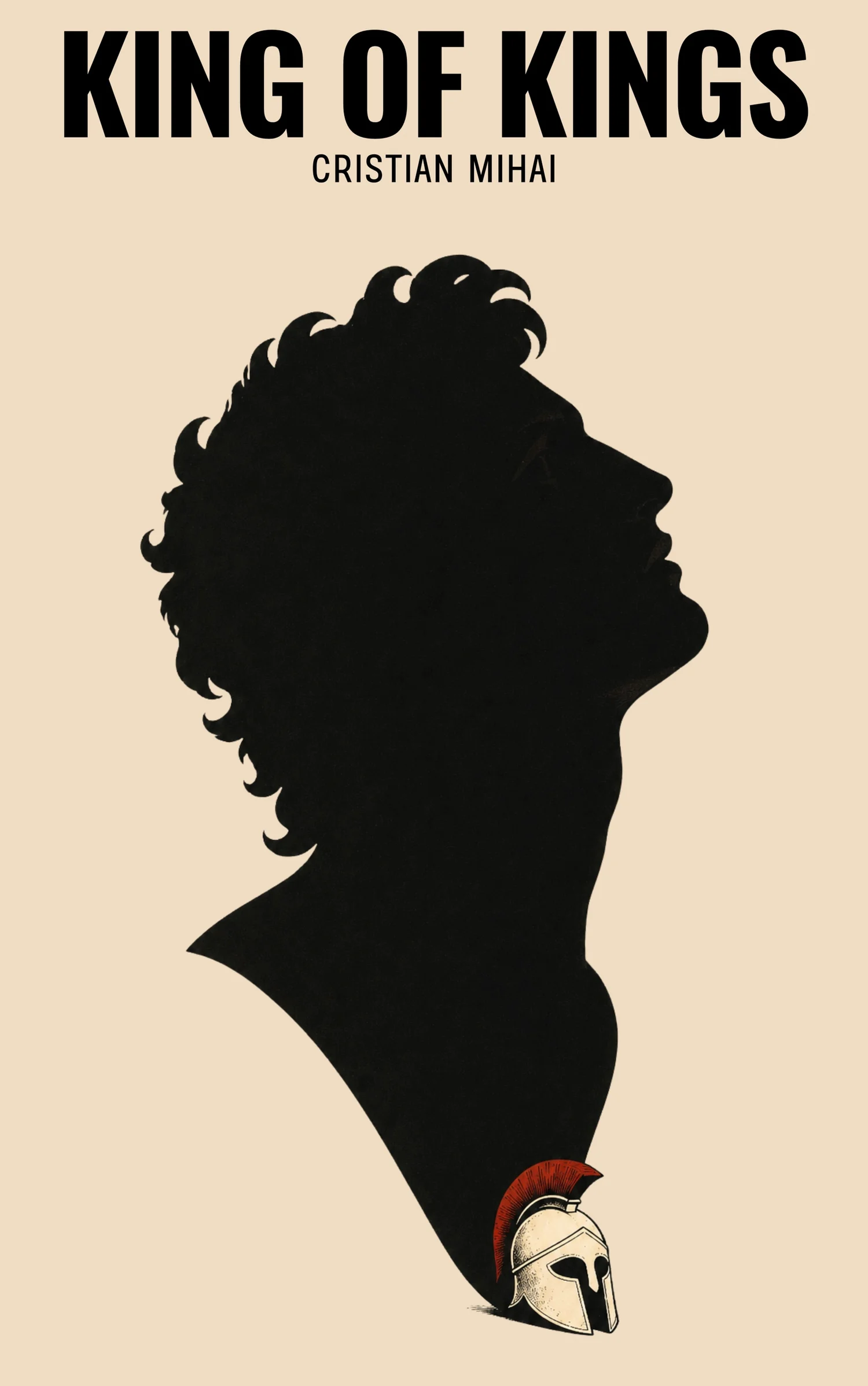
He died at thirty-two, two millennia ago. The ambitious have lived in his shadow ever since.
Alexander the Great conquered everything from Greece to India before most men learn who they are. His soldiers loved him with a ferocity that defied reason. His generals wept at his deathbed. His enemies built temples in his name. Hundreds of years later, emperors still make pilgrimage to his tomb, still measure themselves against his shadow, still fail.
King of Kings moves between Alexandria's sacred crypt and the blood-soaked battlefields of Alexander's ascent. Julius Caesar stands before the sarcophagus and feels his fifty years as a kind of death sentence. Napoleon searches the ruins for a tomb that may no longer exist, chasing a ghost through streets that have forgotten how to remember. Between their visits, the past flickers to life: a boy learning at Aristotle's feet that wisdom means knowing you know nothing. A young warrior proving himself in the chaos of Thebes. A king watching his best friend die and losing whatever part of himself was still human.
This is a novel for those who already know Alexander's story and want to understand why they can't stop thinking about it. For readers who sense that beneath the mythology lies a simpler, more devastating truth: he was just a soldier, the best of them, and the men who followed him knew it in their bones.
They come to his tomb looking for a god. They find something worse. A man who was everything they wanted to be.