And Then, We Woke Up
Buzz leans over a tray of Winchell's donuts, Tuesday's batch. Today, Friday. The glaze fossilized to a petroleum shine three days ago and three flies cemented themselves to the surface, legs up, locked in the sugar. He picks at one with his thumbnail. The fly holds. He picks at the donut. The donut holds. His pupils fill most of his irises, wide and black. They handed out Dexedrine at 4 AM. Standard issue, the man with no fingernails said. Same tablets the Mercury Seven swallowed before their press conferences. Buzz's crew cut has grown out enough to show the gray at his temples, and his hands, square and freckled, won't stop moving, even when the rest of him goes still.
Neil sits in the corner, shirtless, working through his second pack of unfiltered Camels. A girl named Patti sprayed glycerin across his chest and shoulders two hours ago so he gleams under the tungsten spots, the light pooling in the hollows of his collarbones. She hummed while she worked. Schubert. The Unfinished Symphony. Neil held his breath and let her finish.
Between drags he mouths the line. That's one small step for a man, one giant leap for mankind. His jaw works it over, lips moving without sound, tongue pressing the consonants against the roof of his mouth. Forty minutes of this.
Stanley Kubrick stands behind the camera.
RCA TK-60. Serial numbers filed smooth. He keeps his right eye pressed to the viewfinder and his left eye shut, the way he's kept it for six months.
"Cut."
Thirty-seventh time. The word thinned to a reflex weeks ago. He wipes his forehead with the back of his wrist. The soundstage holds at a precise 68°F. Sweat darkens his shirt between the shoulder blades.
Warehouse 7, Burbank. Hitchcock used this stage for the shower scene in '59, and if you breathe through your mouth you catch corn syrup and red dye, sawdust, cigarette smoke.
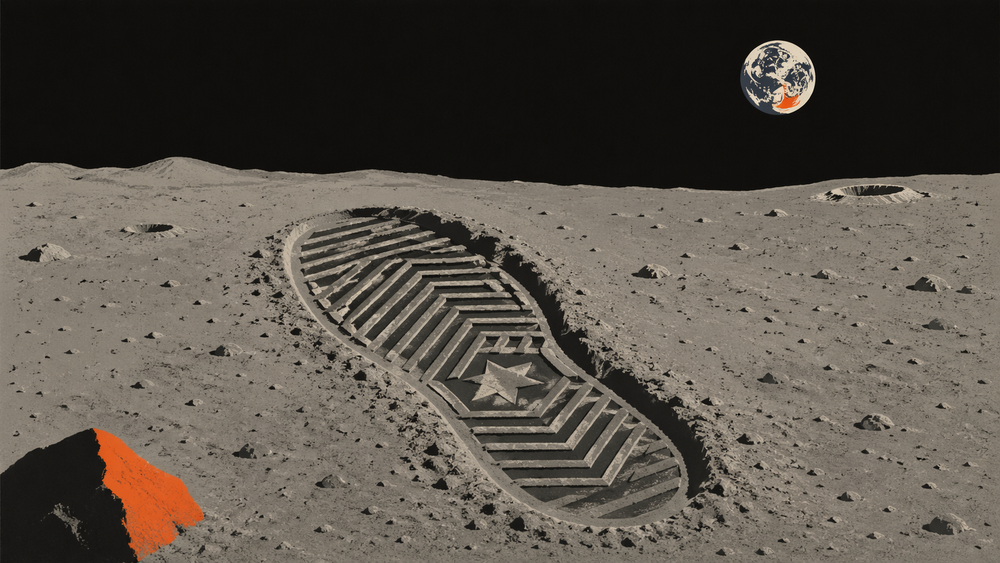
They spent six months building the moon.
Six tons of Portland cement mixed with charcoal ash for the surface. Union boys sledgehammered the craters, passing a bottle of Old Grand-Dad hand to hand between swings. Real craters follow physics, follow four and a half billion years of velocity and mass. These craters follow Friday night. The horizon: muslin pulled taut across pine two-by-fours, painted with hardware-store black. Stars: 847 Christmas bulbs from the Woolworth's on Ventura Boulevard, white, pinned to match a night sky nobody specified. Questions cost more than answers in this building.
The lunar module hangs from aircraft cable rated for 10,000 pounds. The module weighs 73: Reynolds Wrap over chicken wire over balsa wood. In the finished shots it needs to carry the weight of 33,500.
The flag: Taiwan nylon, red stripes printed slightly off-register. Fishing line sewn through the hem, 20-pound test, invisible on camera. Patti holds the line. She pulls when Kubrick nods. Releases when he blinks. Three days of this and she reads his face the way she used to read sheet music at the conservatory in Oakland, before the boyfriend with the van, before the drift that ended here, making the American flag wave on a moon she built from Portland cement and Christmas lights.
The script supervisor, Doris, holds her clipboard against her ribs with both hands. A Virginia Slim burns itself down between her index and middle fingers. Nine minutes since her last drag. The ash holds, a gray cylinder two inches long.
The President's orders arrived on White House letterhead so stiff that Doris sliced her thumb on the edge. She pressed the cut to her skirt and left a small dark half-moon on the fabric, just above the knee. Six months of shooting and the stain held. She ironed around it on Sunday nights.
Six hundred million people would watch the broadcast.