
Angel, the Rabbit
The girl walks her rabbit through Willowbrook Park at 3:42 in the afternoon, during school hours, and no one stops her.
The leash is pink leather threaded with silver bells no bigger than baby teeth, and it clips to a pink harness buckled around the rabbit's chest. Every hop shakes loose a faint ting, ting, ting, and it sounds like champagne flutes touching in a room where everyone is lying. The rabbit weighs as much as a two-year-old. Its fur is the white of a toothpaste commercial. When it hops, the fur comes down with the ring of the bells, and the rest of the rabbit comes down after the ringing stops.
She leads it past the playground, where the mothers stand in a knot around the slide with their lattes. She leads it past the fountain that quit during last year's budget cuts. Monday's rain stands brown in the basin, deep enough to float a drift of oak leaves and cover three pennies on the bottom.
Her patent leather Mary Janes cost eighty dollars, and red clay has dried on both toes. Her dress is the Jacadi kind that mothers buy to make other mothers feel underdressed at birthday parties. Nobody stops a child in eighty-dollar shoes.
Her braids pull so tight that the skin bunches where the blonde meets the scalp, and the part has gone pink and raised. Somebody did this to her while she stood still as a coat rack. Nobody has redone the braids since. Enough nights on a pillow have raised a blonde fuzz along them, and the fuzz holds the light.
A man follows them, and his shadow runs up the path toward the girl and ends well short of her.
His Brooks Brothers shirt came off a sale rack, and this morning's coffee has left a stain on the left cuff. His suit jacket hangs crooked from the weight in the right pocket. His left hand rides in the left pocket, where his thumb works the rim of a bronze medallion. The program gave it to him, and the VI stamped inside its triangle stands for his years without a drink. On every turn, its edge ticks against his wedding band.
He has followed them since the parking lot, and each time the rabbit stops to sniff, he stops and checks his phone. His stride never changes length, his shoulders ride level, and he breathes evenly. His pupils stay wide in the daylight. His collar smells of the sandalwood cologne he put on before his commute and of the sweat his dry cleaner has given up on.
Nobody stops him either. A man in a suit at 3:42 on a weekday looks like a man between meetings. His calendar at the office says dentist. Lamb Elementary sits across Fourth Street on the far side of the tennis courts, and it lets out at 4:15, and he knows its bell schedule the way other men know their tee times.
The path bends into the row of oaks behind the tennis courts, and the playground drops out of sight. For the first time since the parking lot, he lengthens his stride.
The rabbit stops to nose a Snickers wrapper at the edge of the asphalt. The girl stops with it. The man leaves his phone where it is and keeps walking, and his shadow slides up the path toward her, and she speaks without turning around.
"His name's Angel."
His stride stutters and recovers. In his pocket, the medallion turns faster.
"I named him after Mommy. Daddy did my—"
She reaches back and touches the end of one braid. The rabbit's ears swivel apart like two furred satellite dishes working different channels. The man comes close enough to see the bells shiver on the leash.
"What's wrong with Daddy?"
"Daddy's in the ground."
She says it in the voice she uses for Columbus sailed the ocean blue. She bends to stroke the rabbit, and her fingers walk down its spine one at a time like a child practicing scales. Red clay is packed under her fingernails. The topsoil in this county is red clay, and the clay stains whatever it touches and holds whatever you give it.
"He's been there since Monday."
The man laughs. He learned that laugh in hotel bars after midnight, back when he drank, on the nights he gave bartenders his reasons for not going home.
"He's been down there since Monday?"
"Monday's a good day for digging." She doesn't look up. Her fingers find the spot behind the rabbit's ears where the fur grows softest, and she works it there, and the rabbit leans its full weight into her palm. "The ground's softer on Mondays."
"Is that so?"
He takes another step. The sun is at his back, and his shadow runs ahead of him across the asphalt until its head lies against her heels.
"Angel likes Mondays."
"Angel looks happy."
"Angel's always happy." She scratches behind one ear, and the rabbit tilts its head to keep her fingers in the right place. Its eyes half close. It settles lower on the asphalt than a rabbit that size should settle. "He's happy even when he's scared."
"What's he scared of?"
The girl lifts her hand away. The rabbit opens its eyes.
"Rabbits don't scream, did you know that?"
"They do." The medallion has gone slick in his palm. "Only when a dog gets hold of one."
"They just shake." Her voice drops. Three crows lift off a branch overhead and settle one tree over. "Daddy said staying quiet makes you brave."
"Quiet is good." His right hand shifts inside the heavy pocket, and he shows her his teeth. "The world's too loud."
"The world's too loud," she says.
Back at the playground, out of sight, a child on a swing shrieks at the top of every arc.
"Do you go to Lamb Elementary?" He says it too fast, and he spreads the warmth in his voice like frosting from a can. "I volunteer there sometimes. It's called Reading Buddies. The third graders love it."
"I know what school I go to."
"Of course you do." He is close enough now to see the pink along her part. "I just meant—"
"You don't volunteer."
His smile falls off. The afternoon gets a look at the face his wife has never seen, and then the smile climbs back on.
"That's not very nice."
"No, it isn't."
She straightens and turns around.
Her eyes are the blue of nursery walls, and they find his and hold. Her left eye ticks once like a camera shutter.
He glances back along the path. The oaks hide the playground, a green windscreen hides the tennis courts, and nobody is watching.
She tilts her head to the right, and the braid slides off her neck. The newest bruises there are purple and the size of a man's thumb, and the older ones around them have gone green and yellow at the edges.
He looks at the bruises longer than he looks at her face.
The rabbit goes still, and it sits there with the dead weight of a sleeping two-year-old. Its eyes find his and stay on him. They are red where the daylight should turn them pink.
The man's knees lock.
He stands in his body the way people stand in elevators during a power outage. His mouth floods with the taste of a sucked penny, and the spit comes faster than he can swallow it.
The girl wraps the leash twice around her fist.
"Angel doesn't like you."
She says it in the singsong kids use for ring around the rosie, ashes, ashes.
He has to push the words up his throat. "Rabbits don't like anyone."
"That's not true."
She crouches beside the rabbit and puts her lips to its fur at the base of one ear, where the ear thins until daylight shows pink through it. The ear cups toward her mouth. She whispers into it, and the part the man can hear clicks and drags, tchk, tchk, hhhaaa, over and over.
The oaks lean over the path. Their shadows slide across the asphalt while every leaf hangs still. The air on the path goes cold as the inside of a walk-in freezer, and the sun still lies warm on the grass beside it. The man's breath comes out white. The girl's breath comes out white. The rabbit's breath never shows.
The rabbit's throat opens, and one note comes out, high and clean. It is the note a wet finger draws from the rim of a crystal glass, and it holds without a breath. A body the size of a two-year-old should not have room for that note.
"What did you say to it?"
His voice cracks on the last word, and he is twelve years old at the chalkboard with the class laughing at his back.
She does not answer. She opens her fist, and the leash unwinds and slides out of it and lies on the asphalt.
The rabbit hops toward him, and the leash drags after it, and the bells skitter along the path. It hops again. Each time it lands it lands heavier. Its fur runs in waves from its nose to its tail, and nothing else on the path moves.
Its mouth opens. The front teeth are the yellow of old piano keys. The mouth keeps opening, wider than a rabbit's mouth can open, and past the front teeth the man sees more teeth in rows going back, and his legs will not move, and his eyes will not close on the throat where the rows end.
In his left pocket, the medallion stops mid-turn. His thumb will not move. The ticking stops.
The rabbit sits down with its whiskers against the toes of his shoes. They are Kenneth Cole knockoffs. He bought them online after the real pair needed disposal. He has a method for shoes.
The rabbit tilts its head. Its nose presses the air the way a thumb presses a peach for the give.
The girl giggles like a music box running down.
"Angel knows."
The rabbit gathers itself and folds its whole weight down into its back legs, and the fold goes crack like a knuckle in a quiet room.
The man's right hand closes on the weight in his right pocket and draws it up until the black end clears the pocket. His fingers know this grip. His wrist has stopped taking their calls.
The rabbit leaps.
His knees hit the asphalt, and the front of his trousers goes dark and warm, and the medallion drops out of his fingers and rolls away across the path, and the light off the bronze wobbles over the red spreading around his knees, and his mouth opens on a sound with no words in it.
At a playground, screaming is the sound of everything going fine. Nobody at the slide looks up. A swing chain creaks. A mother calls a name. Past the windscreen, a tennis ball hits the court, and a man calls it out. A jogger crosses the far end of the oaks with both earbuds in and his eyes on his watch.
The girl stands up and waits. She waits until the shadow of the nearest oak slides across the path and reaches the toes of her Mary Janes. She finds a strand that has worked loose from her braid, and she tucks it behind her ear. While she waits, the bells on the dropped leash ting whenever the rabbit shifts its weight where the man went down.
When the rabbit comes back to her side, it sits and cleans its teeth. The pink tongue reaches farther than a rabbit's tongue can reach and curls slowly between one tooth and the next. The red on the white fur around its mouth runs in stripes like a candy cane. The rabbit looks up at her. She reaches down and scratches behind its ear, and it leans into her hand with its whole weight, and its eyes close, and its nose twitches, and while her fingers work, the afternoon is a girl and her rabbit in the sun.
She picks up the leash. The bells find their rhythm again.
The man's things lie where he knelt. A stain on the asphalt could be oil or rusty water or the shadow of a cloud that has already moved on. His keys lie in the middle of it, and beside them his phone lights up with a text from a contact saved as Home. The medallion lies at the stain's edge, face up, and the VI in its triangle catches the light. His wedding band has rolled up against it.
The girl hooks two fingers of her free hand into the backs of the loafers and lifts them. She has a method for shoes.
They walk on.
The path comes out of the oaks at Fourth Street. Minivans and SUVs idle nose to tail along the far curb in the pickup line for Lamb Elementary. At the corner, a mother waits for the crossing guard with a toddler on her hip, and the toddler sees the rabbit and the pink on its chin and points. He clicks his tongue and drags a long breath after it, tchk, tchk, hhhaaa. His mother never taught him that.
His mother turns him on her hip until he faces the school doors, and she keeps her own eyes on the doors too. Nobody stops the girl.
The girl hums. Angel's ears follow the tune.
The bell goes off inside Lamb Elementary. The doors swing open, and the first children run down the steps, and their backpacks bounce. The crossing guard walks into Fourth Street and raises her stop sign, and the traffic stops for the girl, and Angel leans into the harness and pulls her off the curb.
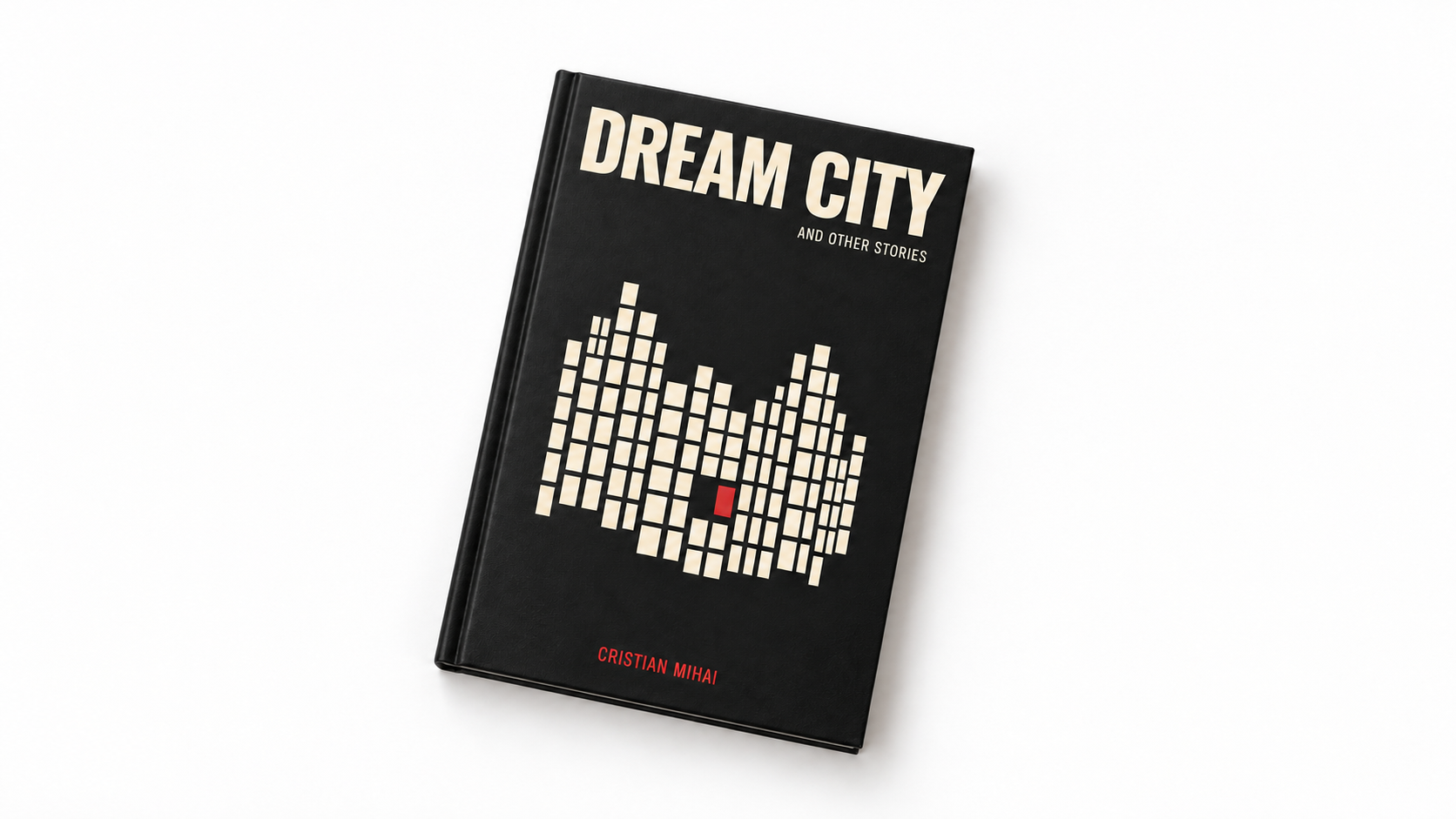
This story is one of forty-two in Dream City and Other Stories. You can read the rest on my e-store or on Amazon.