Love You to Death
Red Bull number four goes warm in the cupholder. The carbonation died an hour ago, the can sweating through the label. Ruth tilts it back, drains the flat dregs, lines it up beside the other three in the passenger footwell.
The Camry idles in neutral. Five days in this parking lot, diagonal to your building, third floor, corner unit. The only window with aluminum foil taped behind the blinds. She confirmed the foil on day one by climbing the fire escape at 2 AM and pressing her face to the glass. Your shape in the bed. The blue glow of a phone screen on your cheekbones. The lungs of a man who sleeps through the night.
She mapped the access points on graph paper her first week. The super named Gregorio props the service door with a cinder block every morning between 6:15 and 6:40 while he smokes his Pall Malls to the filter. The window latch you pried loose last month for the cross breeze. The WD-40 she worked into both hinges during your Tuesday gym routine three weeks ago, standing in your apartment with a rag in one hand and the can in the other, testing the swing of the door until the hinges gave up their sound.
Her thumb moves across the glass.
Where are you?
Send. The timestamp sits beneath the message like a date of death.
Miss you.
Send.
Call me.
Send.
In the cupholder beside the dead Red Bull: a prescription bottle. The label reads Daniel Vasquez. Xanax, 0.5mg. Take as needed for anxiety. Ruth shakes one into her palm. The pill leaves a chalky ghost on her lifeline. She places it on her tongue like communion and lets it dissolve.
She checks the Timex strapped to her wrist. Men's size, the leather band worn soft at the third hole where a thinner wrist once buckled it. 9:32 PM.
The foil in your window catches the sodium lights and throws them back. No shadow crossed behind that dull silver square in three hours.
In the passenger seat: a black Moleskine, its elastic band stretched slack. She picks it up and opens it to a dog-eared page the way someone else might turn to scripture.
His handwriting. Daniel's. The lowercase letters careful, evenly spaced.
February 14: Matched with someone. Ruth. She's intense in a way I can't pin down. We talked for three hours. She ordered the same thing I did. Coincidence or compatibility? Either way. Either way.
She practiced that handwriting for six weeks on a legal pad, filling page after yellow page until her version and his became the same hand. She still practices every night, ten minutes before sleep, the way a pianist runs scales.
February 28: She has a key to my apartment. I didn't give her one. She says the landlord let her in. But she was standing in my kitchen making eggs when I woke up, and the eggs were perfect, and I was too tired to ask the right questions.
Ruth turns the page. The handwriting tightens here, the letters compressing against each other.
March 1: I told her I need space. She agreed. She was calm. She was so calm. But the door doesn't open from inside anymore. She changed the deadbolt while I slept. I can hear the TV in the living room. She's watching something. I can smell dinner.
March 2: She won't let me leave. She changed the locks while I was sleeping. I can hear her on the other side. Help. Someone. Please help.
The word help gouged so deep the ballpoint tore through to the next page.
Ruth's entry, written the following day in a hand indistinguishable from his:
March 3: Never mind. Misunderstanding. We talked it out. Everything's perfect now.
The forged entries run for months after that. His handwriting steady, placid, describing hikes he never took and books he never read and a peace he never found.
Missing person report filed March 10. Case closed April 1. Insufficient evidence.
Ruth closes the Moleskine. Runs her thumb along the spine. Beside it on the passenger seat: a sealed Ziploc holding a left Gold Toe athletic sock, size 10-13, pulled from his gym bag while he ran intervals on a treadmill seven months ago. The cotton lost his scent weeks after she sealed the bag, the plastic eating the last molecules. She holds it anyway when the nights get long, presses it to the bridge of her nose, breathes in nothing, and stays.
She settles deeper into the seat. Five days have molded the Camry's upholstery to her body.
The messages accelerate.
Please call me.
Where are you?
Don't do this.
Your phone rattles across the IKEA Malm nightstand, the one you assembled with a butter knife because you lost the Allen wrench. The bottom drawer faces backward.
Do you know what's really funny?
The rattling stops. Your studio fills with the silence that follows a sound.
You left the window unlocked.
You sit up. The sheets fall to your waist. Your eyes cut to the window, and the tendons in your neck pull taut beneath the skin. The latch. Three previous tenants painted it shut. You pried it loose last month with a flathead screwdriver. For the cross breeze, you told yourself. July heat in a studio without AC. Sweat beads between your shoulder blades and tracks your spine, vertebra by vertebra.
Still not gonna talk?
Fine. Let's play a game.
The phone rattles itself to the edge of the nightstand. Tips. Crack. A spider web fracture blooms across the screen. The phone keeps buzzing against the hardwood, a bluebottle fly dying on its back.
Your front door opens without sound. Ruth guides the latch into the strike plate the way you'd lower a lid onto something sleeping.
She moves in sock feet. Her Nikes stay at the threshold, lined up beside your Vans, toe to toe. Seventeen entries burned this studio into the backs of her eyes down to the quarter inch: the kitchenette with its two-burner stove and the cast-iron skillet still wearing last night's grease, the bathroom where the shower curtain hangs two inches short of the tile, the closet holding three identical black t-shirts and two pairs of Levi's 511s.
The studio smells the way you smell. Sandalwood deodorant and the ghost of whatever you fried for dinner and the particular warmth that builds in a room where a body sleeps with the windows shut. Sodium light from the parking lot stripes the kitchen ceiling in pale bands. She draws it in through her teeth.
You sit on the bed. Back against the wall, knees drawn up, the cracked phone in both hands. Green bubbles scroll past, reflected in your eyes from six feet away through the kitchen pass-through. The vein in your temple ticks, the one that surfaces when the machinery behind your face engages.
I can see you.
Your head snaps up. Your eyes sweep the studio: window, closet, bathroom. Your pupils blow wide in the dim, the black swallowing the brown. The phone shakes in your grip.
Ruth holds still. The pass-through frames her from the chest up, and the kitchen sits dark and your eyes haven't adjusted and she wears black on entry nights, always black, the discipline of a woman who has done this sixteen times before.
You have two choices. Come to me. Or I'll come to you.
She watches you read the words. Watches the vein in your temple go still. Watches your chest expand with one long breath and hold.
Then you smile.
You stand. Plant both feet on the hardwood. Hold the cracked phone in front of you and turn a slow circle, arms lifted from your sides, turning the way a figure on a music box completes its single revolution. Your face passes through the window light and the smile stays, and behind the smile your eyes have gone flat and dry and patient, the eyes of a man who finished being afraid before the door opened. Your eyes find the pass-through. They find the dark. They settle there, and they do not look away.
Ruth's diaphragm locks. Her hands go flat against the counter, fingers spread, and the laminate is cool and slightly greasy beneath her palms. She built decision trees on graph paper for this. Fourteen possible outcomes, probability-weighted, color-coded.
None of them looked like this.
Your reply arrives. Green text on fractured glass.
Funny thing, Ruth.
Three dots pulse on her screen.
Your bedroom light's still on.
Pause.
You should probably turn it off.
Her Samsung slips and hits the hardwood. Crack. The screen splits corner to corner.
She spins toward your window. Past the parking lot. Across the street. Her building. Her unit. Third floor, corner.
The Pottery Barn lamp, brushed brass, glows behind her curtains. Five nights of watching that silver square of foil on your window, and every one of those five nights her own lamp burning at her back, marking her apartment for anyone who cared to look.
A figure stands in that warm circle.
Wrong height. Thinner through the shoulders, narrower at the hips. But the stance catches in her sternum like a hook set deep: weight shifting from left hip to right and back, a small pendulum she watched across a table at a ramen place on Division Street on February 14 while she mirrored his chopstick grip and laughed when he laughed and memorized the serial number on his Timex Weekender.
She looks at the watch on her wrist.
She looks at the figure in her window.
Daniel Vasquez waves at her from her own apartment. The wave comes slow, metronomic, the steady sweep of a man who wants you to understand the clock belongs to him now.
Ruth's knees buckle. Her shoulder blades hit the drywall, and she slides until the cold of the kitchen tile bleeds through two layers of black cotton. Her fingers curl against the grout lines. Each breath fogs the Samsung screen when she picks it up.
How?
The reply comes instant. No typing indicator. Pre-loaded, chambered.
I followed you home.
Been following for a while actually.
Through her window, Daniel moves. Steps out of the lamp's circle into her living room. His shoulders ride lower. He crosses her floor the way water moves through a broken dam.
Her Samsung buzzes. Photo attachment.
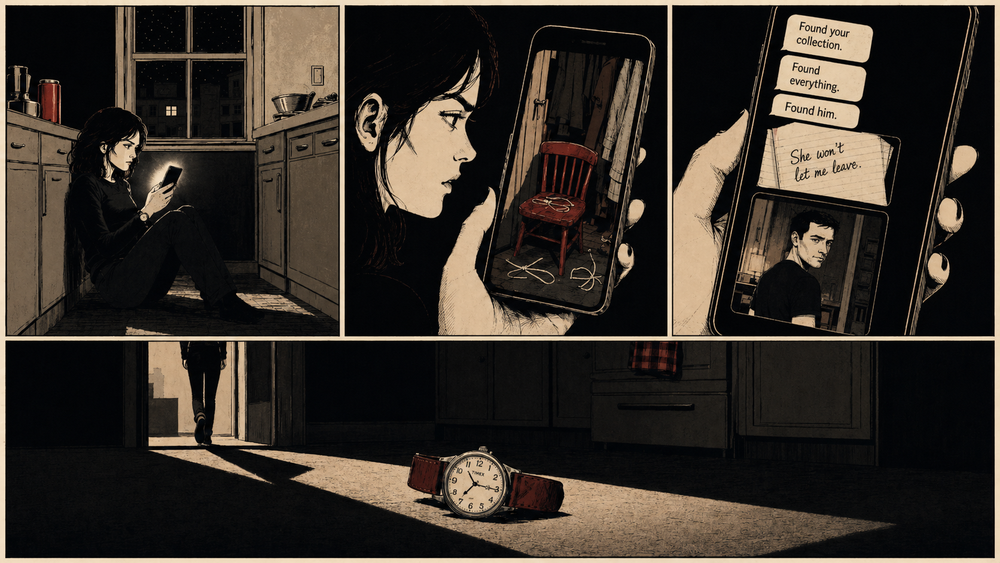
Her bedroom. Her closet door, open. The winter coats shoved aside. Behind them, where the fabric hung thick enough to swallow a wall: a wooden kitchen chair. White zip ties, cut clean, curled on the seat like shed skin. Grooves worn into the chair's arms where plastic bit into wood for months. The grain runs in channels now.
Buzz. Another photo.
The Moleskine, open to March 2. The real March 2. Daniel's handwriting and the ballpoint that tore through the page. She won't let me leave.
Buzz. The third photo loads slow, in horizontal bands from the top down.
You and Daniel. A selfie. Your arm around his shoulders, both grinning, the angle from slightly below. Daniel wears a gray crewneck she has never seen. His face thinned, the skin loose at his jaw, the cheekbones casting shadows they didn't cast on Bumble. But his eyes stare through the cracked screen and find her on the kitchen floor. On his wrist: a Timex Weekender with a new leather band, the replacement for the one ticking against Ruth's pulse, the one she unbuckled from his wrist while he sat zip-tied to a kitchen chair behind winter coats in the apartment where she kept her collection and filled a legal pad with his handwriting every night like a pianist running scales.
Found your collection, Ruth.
Found everything.
Found him.
You like games?
The power cuts. Her apartment drops to black, the Pottery Barn lamp killed, and the window becomes a dark mirror throwing back sodium lights and the Walgreens sign. Five days of watching your building, and the whole time, in the apartment she left burning at her back, a door was opening that she never locked because no one had ever walked through it before.
Ruth sits on your kitchen floor. The Samsung glows in her lap. One final message.
I love you, Ruth.
I love you to death.
She reads the words twice. Her thumb tracks across the cracked glass, shaping a reply she doesn't send. She locks the screen. The glow dies.
The Timex ticks against her wrist. She presses two fingers to the crystal. Beneath the glass, the second hand sweeps past the twelve and starts again.
Across the street, a door opens. The sound carries through your window, through the gap where the night air smells like cooling asphalt and jasmine from a planter box the previous tenant left behind.
Ruth slides her thumb beneath the leather band. The brass buckle bites her wrist bone, holds at the third hole, and gives. The watch drops into her open palm, and the skin beneath it breathes for the first time in months, a pale stripe of flesh where the band pressed tight against the vein.
She sets the Timex on your kitchen floor and stands. It keeps counting.

Dream City and Other Stories
Dream City and Other Stories collects forty-two stories like this one. Some of them are worse.