Ninety Minutes
The alert arrives as a chime, then as a color. Down the console bank, screen after screen trades its operating green for advisory yellow, and the duty phone begins ringing with the tone reserved for the reliability coordinator, the tone nobody at Harker Road has heard outside a drill.
Russ Ward sets his coffee on the laminate, square to the edge of the desk the way he squares everything, handle out, the same as the last eleven years of cups. He reads the space weather feed the way you read the side of a pill bottle, scanning past the name straight to the dose, and tonight the dose climbs off the bottom of the label and keeps going.
X-class flare in progress. Coronal mass ejection observed. Earth-directed, full halo. Estimated transit: ninety minutes.
He reads it twice and the transit time stays wrong both times. These things take days to come. The bad ones take a day. The bulletin gives this one a velocity, and he runs the velocity against the distance with hands that have run load flow since before Nora could walk, and the answer sits there, ninety minutes, and will not be argued down. The sun has fired the biggest round it has ever loaded, square at the only planet with the lights on. The bulletin calls it ejecta. The bulletin gives it a mass with more zeros than any number he is licensed to operate.
Dale Hennig comes out of the supervisor's office with his reading glasses pushed up into his hair. Dale worked this desk back when the map board ran on light bulbs and a man with a pole changed them. He owns a voice for drills and a voice for weather. The voice he uses now belongs to neither.
"Tell me the feed is wrong," Dale says.
"The feed is wrong every day. Tonight it agrees with both satellites."
The wall clock over the map board reads 11:42 when Russ logs the event, and under the event field where the form wants a category, he types the one the procedure offers and has never once used. GMD. EXTREME.
The procedure for a geomagnetic disturbance runs a single page, and the page runs in one direction. Shed load. Protect the transformers.
Here is what they teach you in the first week, before they let you touch a breaker. A high-voltage transformer is the size of a house. It holds enough mineral oil to fill a backyard pool, and the copper inside it was wound by hand, by people, in a building on the far side of an ocean. It travels on a rail car built for nothing else, escorted, at walking speed, with the route surveyed for bridges a year in advance. The factory that winds one takes a year and a half to wind it, and the factories live overseas, and nobody keeps spares, because the spare for a thing like that is the thing itself. So you decide ahead of time what you can stand to lose, and you build that decision into the relays, because a relay never hesitates and a man always does.
Shed load. Protect the transformers. Black out the towns to save the machine that lights the towns. It reads like cruelty until you price the alternative, and then it reads like the only mercy on the menu.
Katie Brandt is already on the bridge line with the interconnection, repeating coordinates back in her flat northern voice, writing on the desk pad with a pen and then with a second pen when the first gives out. Dale stands at the map board with his arms folded, looking at Ohio the way a man looks at a yard he has mowed his whole life and now has to sell.
Russ opens the binder even though he carries the page in his body. The page says bring every unit online for voltage support, reduce transfers, sectionalize. Then it gets to the verbs nobody says out loud on a normal night. It says open. It says drop. It says shed. The tab marked GMD still snaps like new plastic.
In 1859 the storm came with no warning at all. Telegraph operators watched sparks walk off their keys and set the message paper smoking, and when they disconnected the batteries to save the equipment, the lines kept sending anyway, on aurora current alone. Operators in Boston talked to operators in Portland for two hours on current that fell out of the sky. The sky did the job better than the batteries had.
In March of '89, a storm a fraction of this size took the whole province of Québec from console to candles in ninety-two seconds. That number burned into Russ the way a static image burns into a monitor left on too long, the ghost riding under every reading since.
The phone rides in his shirt pocket, over on the left, and his whole torso has learned to favor that side, a lean so slight only a tailor or his wife would have caught it. The contact reads NORA, then the area code for Seattle, then a photograph from the year she turned nine, squinting into the lens like she'd been asked to do something stupid, with a perch held out by the line because she refused to hold it any other way.
He has run this call on every drive home since the funeral. In the version he runs, he opens with her weather, because Seattle weather is a free square, and she lets him get to the second sentence. In the version he runs, she says, "I was going to call you," and the lie sits between them like a gift both of them agree not to open. He has the whole script. He has his lines and he has hers.
Katie covers the mouthpiece. "They want our shed schedule in ten."
"They'll have it in five," Russ says, and starts killing towns.
This is the work, and the work is his because the units are megawatts and the megawatts are his. A town fits under a cursor. The software asks twice, because the software wants the record to show that you were sure. Fostoria gives up six hundred. Tiffin gives up four-eighty. He takes the Bayshore feeders, the lakefront, the glass plant that runs all night because cooling glass on a schedule is the whole business. Out there in the dark each breaker lets go with a boom that carries across its own switchyard, and in here it sounds like a left click, and whole counties end. The hospital south of Findlay carries generators sized for a long siege. The dialysis center on the Fostoria feeder carries a transfer switch that either works tonight or does not, and the screen that shows Russ the breaker shows him nothing about the switch.
Each town he drops buys minutes for a transformer. Nobody will ever thank him by name. The protocol's whole genius is that the man who pulls the trigger sees only a number changing color. Somewhere, every apocalypse is a dialog box, and somebody clicks yes.
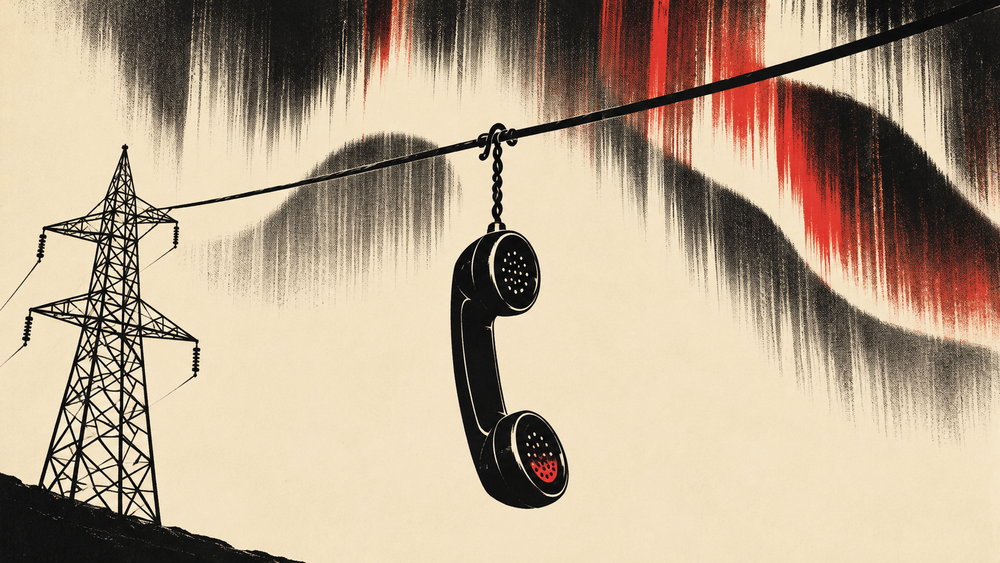
At 12:04 he calls her the first time.
He does it standing at the end of the console row, facing the wall, the way the smokers used to stand at the door before the door went card-access. The ring goes long. Then her greeting plays, the one recorded years ago on a phone two phones back. You've reached Nora, leave it after the thing, and behind her voice, faint, in the kitchen of a house that has since been sold, Carol laughing at whatever Nora's face did while she recorded it.
The greeting runs maybe six seconds. Russ has heard it more times than he has heard most living people. He plays those six seconds the way other men play the lottery.
"It's your dad," he says to the recording. "I know you don't pick up for me. Pick up for this. Something is coming and I need to tell you what to do."
He texts her the same and puts the phone back in the pocket, and for the rest of the hour he pulls it out and checks it the way you check a pregnancy test you've already read, tilting the screen, putting it back, pulling it out again, as if the answer might revise itself between looks.
The wide-area emergency alert goes out at 12:19, federal, all phones, no opt-out. Every handset in the control room sounds at once, a dozen of them, the harsh paired bursts stacked into one wall of braap braap braap, and Katie, still on the bridge handset, lifts her blaring phone off the desk by two fingers, drops it into a drawer, shuts the drawer with her hip, and keeps reading switching orders into the line.
EXTREME GEOMAGNETIC STORM. PREPARE FOR EXTENDED LOSS OF ELECTRIC POWER. That message is on Nora's phone right now, on her screen, in her hand. It got to her apartment without calling twice, without leaving its name after the tone, without asking her to please pick up. Twelve words from nobody she knows, and she is reading every one of them.
The room takes back its noise, the cooling fans, the bridge line, Dale's pen.
On the feed, the radiation arrives ahead of everything else, and the satellite parked sunward of the Earth, the last tripwire, goes from data to snow to nothing, its detectors whited out by particles running in front of the mass. The storm has blinded the one instrument that exists to watch the storm. Whatever the numbers read in the final clean second, they pinned.
"Arrival oh-one-twelve," Katie says. "Give or take."