Now Serving
The ticket says forty-four.
The counter on the wall says nineteen.
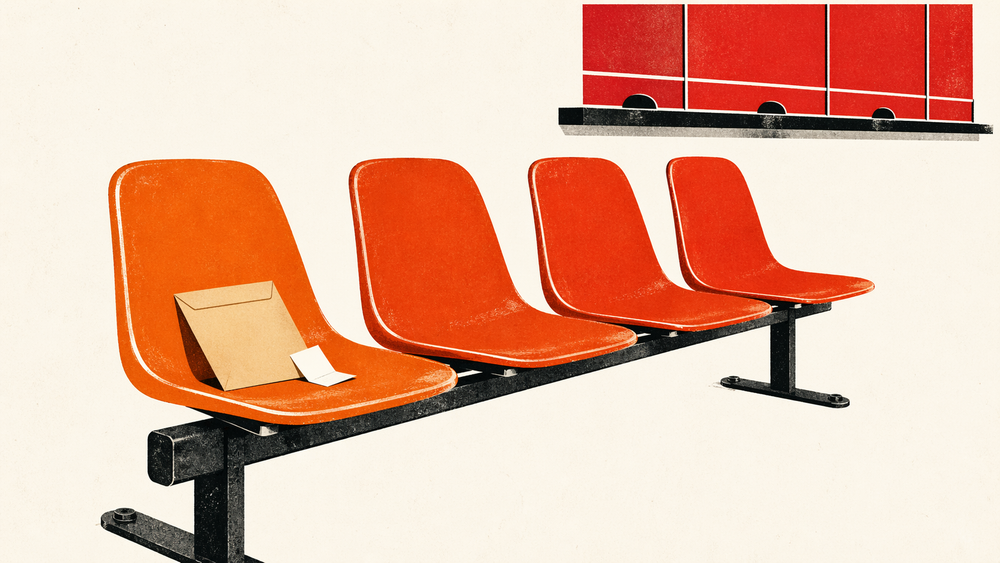
Glen folds the ticket once, then again, pressing the crease with his thumbnail until the paper whitens along the fold. The chairs are the bolted-down kind, orange plastic scooped into the shape of a body that has never sat in one, and the legs are welded to a steel rail that runs the length of each row. The plastic is warm where his thighs touch it, and where his thighs don't touch it, the plastic is cold, and the border between warm and cold moves every time he shifts his weight. His lower back has already started to set the way mortar sets, hardening into the shape of whatever holds it.
The clock behind the reception window reads ten-fourteen. He's been here since the parking lot was empty and the building smelled like the first run of the HVAC system, that stale metallic push of air that's been sitting in ductwork overnight, tasting like the inside of an aluminum can.
The ceiling tiles are standard two-by-four mineral fiber, water-stained in one corner where the roof flashing has failed. The discoloration spreads from the HVAC duct, the underlayment compromised at the curb joint where someone skipped the sealant. His hands trained his eyes. Two decades of climbing other people's roofs, reading water paths and flashing failures, and now every building tells him how it will fall apart.
The woman next to him opens her purse. She takes out a compact, looks at herself, puts it back. Takes out a pen. Click. Click. Puts it back. Takes out a folded piece of paper, unfolds it, reads it, folds it again. The purse is large and brown and organized into zippered compartments, each one a small jurisdiction. She catches Glen watching.
"Margot," she says.
"Glen."
"The thing is," Margot says, "I got here at seven-thirty."
She says this like a line item on an invoice. A billable hour. Non-refundable.
Across the aisle, a kid in a Converge t-shirt bounces his leg so fast the bolted chairs rattle down the steel rail, the vibration traveling through the welds and into Glen's seat, a low hum he can feel in his tailbone. The kid looks young. Skinny the way people are skinny when they've stopped thinking about food, when the body is just the thing that carries the head around. His manila envelope sits on the chair beside him, thick with forms, the metal clasp bent open so the prongs stick up like two small antennae receiving a signal no one else can hear.
Everyone has the manila envelope.
Glen filled his out at the kitchen table two weeks ago. Beneficiary information. Medical history. A section titled "Preferences" with boxes to check. A signature line at the bottom of every page, and below each signature line the same sentence in italics: I confirm this decision is made voluntarily and without coercion.
The kid catches him looking and grins. "Wild, right?"
Glen says nothing.
"I mean this." The kid gestures at the room. The rows of bolted chairs. The LED counter frozen at nineteen. The reception window where a woman with reading glasses on a beaded chain picks up a phone, puts it down, picks it up again. "You'd think they'd have a better system."
"You'd think."
"I'm Darren." He leans forward, and Glen gets the full broadcast, the aerosol layer already cracked and peeling back like old primer, the kid's actual smell pushing through, salt and onion and the particular sourness of someone who sweated through their shirt and let it dry and sweated through it again. “You'd think, right, with all the paperwork they make you do, the consultations, the whole thing where they ask you if you're sure, then they ask you again, then they send you home and call you two weeks later and ask you one more time, you'd think after all that, the actual day-of would be, I don't know. Streamlined."
Margot clicks her pen.
"The thing is," she says, "they only have two rooms."
"Two rooms," Darren says. "For this whole building. For this whole city, basically."
A man two rows ahead turns around. His spine surrendered to a desk chair decades ago and never filed an appeal, the thoracic curve locked into a permanent forward lean. He holds a clear plastic folder with his paperwork arranged in chronological order, tabs labeled in a small, ruled hand.
"Three rooms," the man says. "One is reserved for couples."
Margot stops clicking her pen. Darren's leg pauses mid-bounce.