The Lamp at the End of the Dock
He kept one green light burning at the end of the dock, and no one paid him to do it.
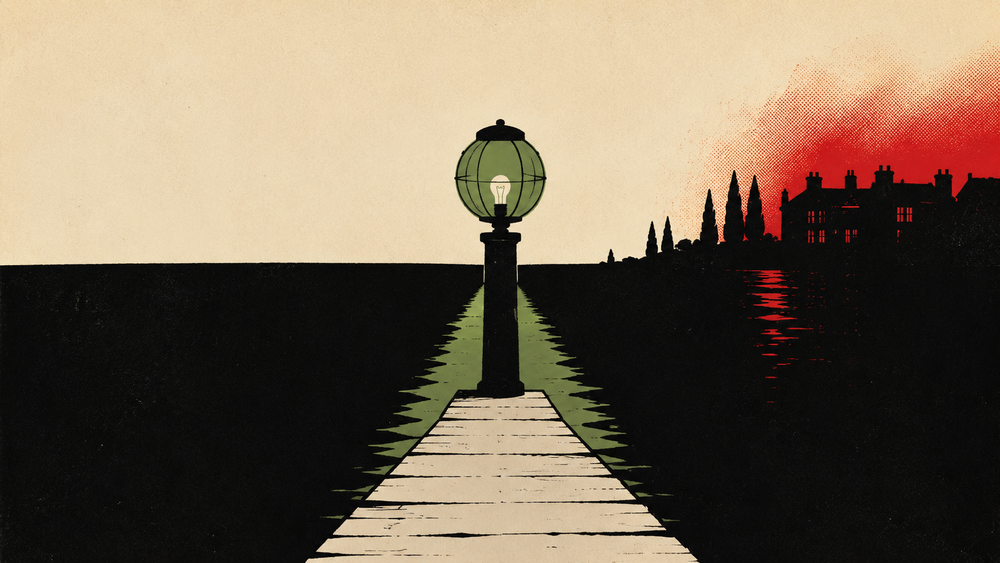
The dock ran out over black water from the East Egg shore. At the end of it, inside a globe of green glass, he kept a single lamp burning, and the green of it fell on the water and made a lane there, a long green road that ran out into the dark and stopped where the dark grew stronger than the lamp.
Slap. Slap. The water worked at the pilings under the planks. It had worked at them for thirty years and would go on after he was gone.
His girl had gone in off the end of this dock. Nora had swum at night since she was small, out along the green lane and back, her arms white in the light of it, and he had stood here with a towel over his arm and watched the water close behind her and open again. She went out one night at the turn of a summer, the water still warm, out along the green where it lay on the black, and she went on past the place the green stopped. He took the boat out. He took the long hooks the baymen kept for the drowned and he dragged the bottom of the bay until the sky went gray. The water gave him a shoe and a length of weed. It never gave her back.
He kept the lamp. No one paid him to keep it. The estate that had wired the line had changed hands twice and forgotten the current ran in it, and he bought the bulbs himself, a few cents apiece, and went out each night and kept it burning, the green she had followed out past the end of its own reach.
A man rowed over in the last week of the season.
The electrician heard the oarlocks before he saw the boat. Creak. Creak. A young man in a black servant's coat, pulling clean and steady over the flat morning water. He shipped the oars and caught the ladder and came up onto the planks, brushing the wet from the knees of his trousers.
"You keep the light," the young man said.
"I keep it."
"My master sent me." He drew an envelope from inside the coat, a figure inked across the face of it. "He wishes it to burn always. Every night of the year. He'll pay whatever you ask, and pay it again each year after, only so it never goes dark." He held the envelope out across the planks. "There is the start of it there."
The electrician looked at the envelope and did not take it.
"He watches it," the young man said. "Every night, from the lawn." The young man smiled, glad to be carrying so fine a thing across the water. "He says there's a lady at the far end of it. A promise. He reaches for it of a morning. I have seen him do it." He set the envelope on the planks and weighted it with a stone from his pocket against the wind. "Keep it lit, and my master will see you never want for a thing."
Slap. Slap. The water went on at the pilings.
The electrician looked out across the bay at the dark house, and at the green lane that ran from his lamp toward it and gave out in the middle of the water where the dark won.
"Tell him it's a bulb," he said.
The young man's smile held. "Sir?"
"A bulb inside a bit of glass. I put a new one in when the old one goes. They come in a box."
The young man took it for the talk of a simple man, and was kind about it. "He'll pay for the bulbs too," he said. He went down the ladder into the boat and pushed off and pulled away over the brightening water, creak, creak, small, and then smaller, until the morning had him.
The envelope lay on the planks with the stone on it.
The dawn came up gray over the bay and took the gold from the far windows of the house where a man had sent a fortune across the water to keep the most beautiful thing he owned. The green of the lamp went pale in the new light. In an hour the sun would have it, and no one across the water could tell whether it burned at all.
The electrician went up the dock to the post where the line came out of the conduit. He had the pliers in the canvas roll with the cotton waste and the spare bulbs. He took them out. He found the wire where it left the conduit and set the jaws on it.
Snip.
The lamp at the end of the dock went out.
The green stayed on the black water a moment after, a green ghost along the lane she had swum, and the water was slow to let it go. Then the dawn came down on the bay and the water was water again, gray going to silver, and the lane was gone, and there was nothing on all that water to reach for.
The man came out the next dawn to the edge of his lawn. The electrician watched him from the dark of the boathouse. He stood a long while looking at the place the green had been. He put his arms out once, and there was nothing in front of them, and he brought them down. He came out the dawn after that and stood and did not raise his arms. After that he did not come.
Word crosses a bay the way it crosses anywhere, by boys and fishmongers and the back page of a paper. Before the week was out the electrician heard that the man from the great house on the far shore had been found in his own water at the foot of his garden, floating, his evening clothes still on him, and that no one could say how he had come to be there.
The electrician went out to the end of the dock at dawn. The socket stood cold in its collar, the green glass beaded with the night's wet, the filament inside it hung dead and fine as a hair. The envelope lay on the planks still, swollen with the damp, the ink of the figure bled to gray. He left it where it lay. He put his hand to the cold glass and turned it once in its collar, the way he had each night when he went to change the bulb.
You spent this story on the keeper's dock, watching a stranger worship a light across the water. That light burns at the center of my novel, The Green Light.
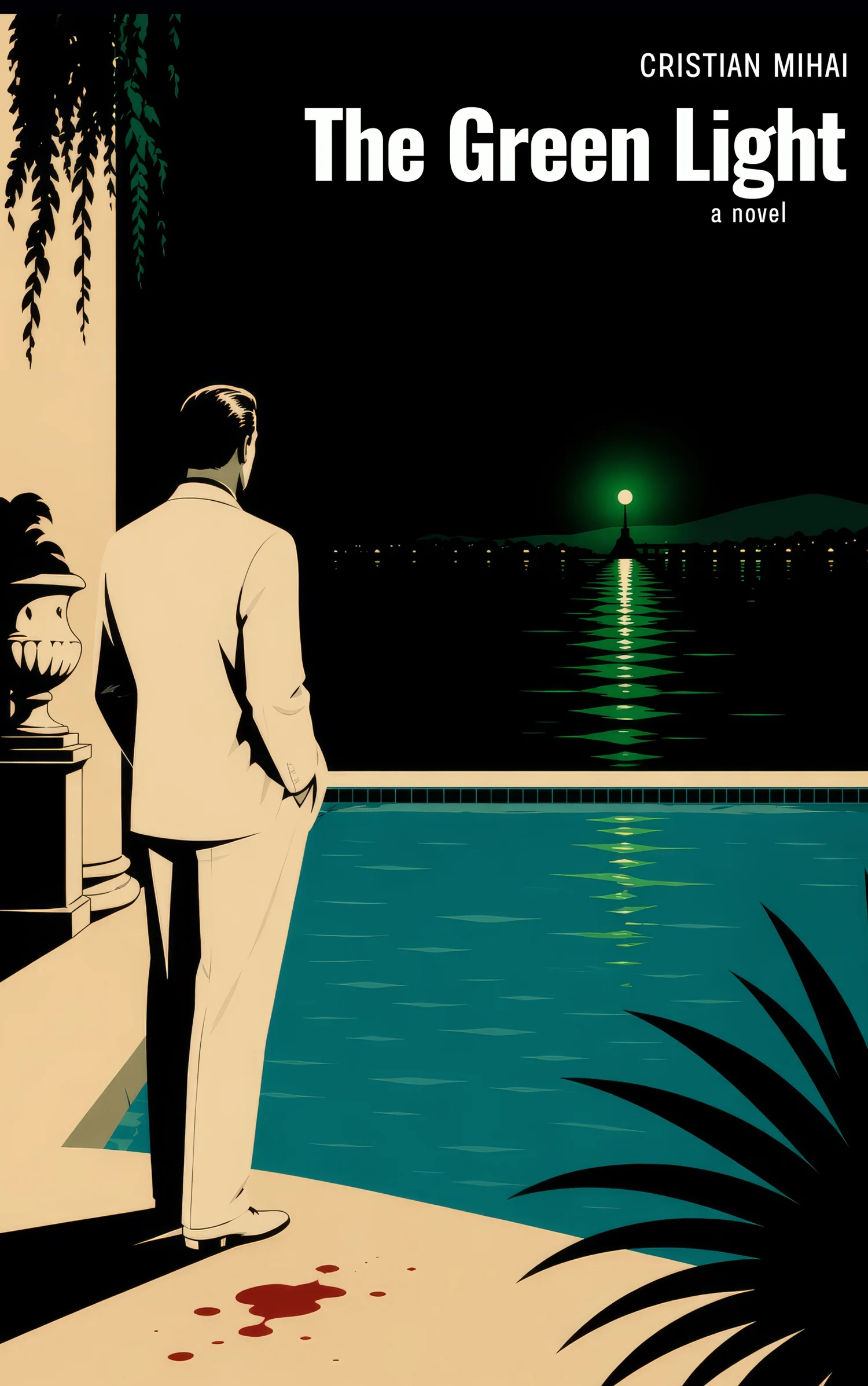
In Fitzgerald's book, Wilson's bullet finds Gatsby by the pool, and that is the end of him. In my novel, I let the bullet miss. Gatsby lives. He marries Daisy. He wins the green light, the woman, the long years, every bright thing he ever reached for. The dream comes true. That is the horror of the book.
Cross the water. The Green Light is available now, direct from my store and on Amazon.